AI in Business Travel: A Practical Guide for Leaders & Business Travelers
Business travel is entering a new phase. After years of disruption and recovery, companies are traveling again at scale, but the expectations surrounding travel management have changed significantly. Organizations today must balance growth, cost discipline, employee experience, compliance, and risk management, all within an increasingly complex global environment.
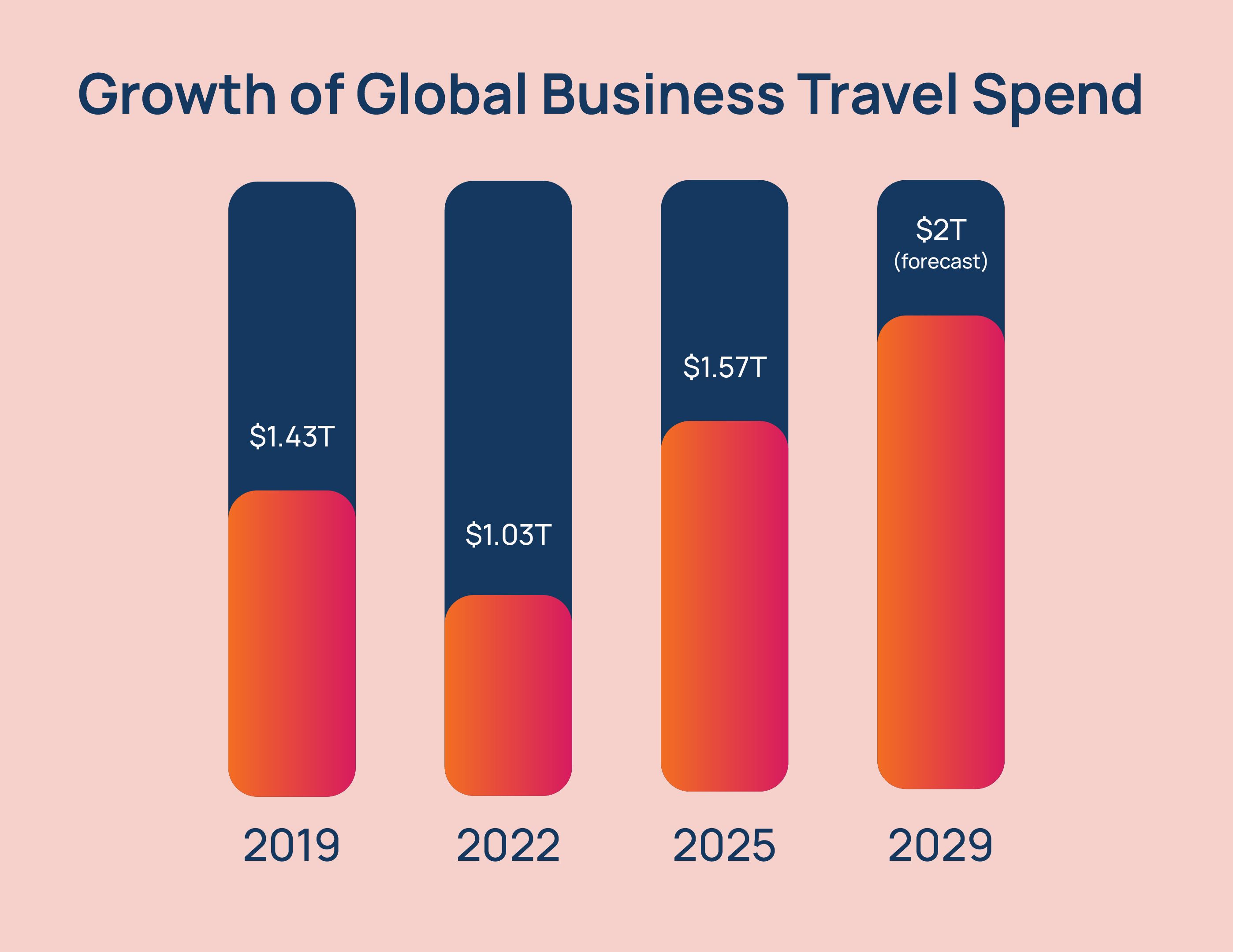
According to the Global Business Travel Association (GBTA), global business travel spending is projected to reach $1.57 trillion in 2025, with continued growth expected to push spending close to $2 trillion by 2029. At the same time, another study says the average cost of a business trip has increased to approximately $1,128 per traveler, reflecting rising airfares, accommodation costs, and operational expenses. This scale creates both opportunity and risk. As travel programs expand, companies face several operational challenges:
- Rising travel costs and budget pressure
- Fragmented booking and expense systems
- Limited real-time visibility into spend
- Complex compliance requirements
- Increasing expectations from employees for seamless travel experiences
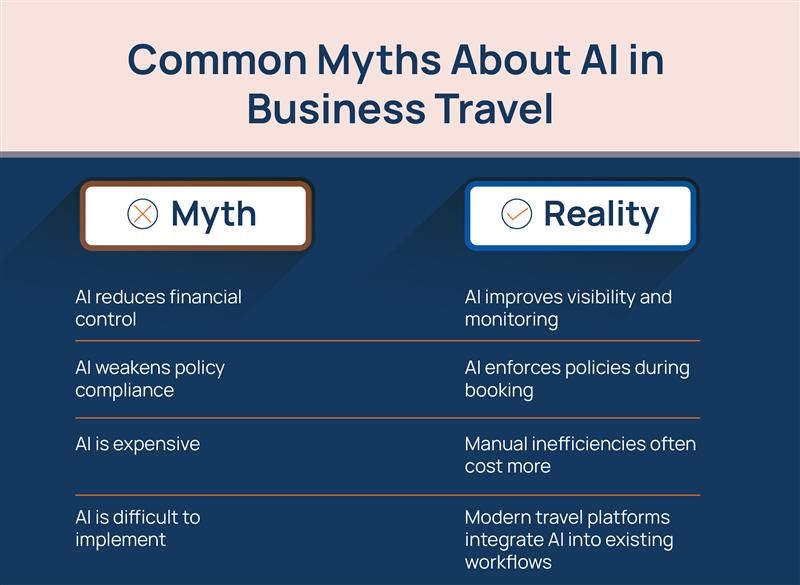
Artificial Intelligence (AI) is emerging as a critical solution to these challenges. Rather than replacing human decision-making, AI functions as an operational intelligence layer that helps organizations make better travel decisions, faster and with greater financial control.
Why Business Travel Needs AI Now
Business travel has historically been managed through manual processes, static policies, and disconnected tools. Travel policies were typically distributed as PDF documents, approvals were handled through email chains, and expense reporting relied heavily on manual data entry.
While these methods worked when travel volumes were smaller, they struggle to support modern travel programs. Today’s business travel environment is defined by:
- Distributed global teams
- Frequent cross-border travel
- Dynamic airline pricing
- Increasing regulatory and compliance requirements
- Greater focus on employee well-being
Corporate leaders must now manage travel programs that operate across multiple departments - finance, HR, procurement, and operations - while still maintaining cost control.
Research indicates that over 90% of travel managers have already begun using AI or generative AI tools, primarily to reduce costs, improve traveler experience, and enhance travel data analysis.
More importantly, organizations deploying AI-powered travel systems have reported measurable financial benefits. Studies show that AI-enabled travel platforms can reduce total travel program costs by approximately 23%, primarily through better compliance, smarter booking decisions, and automated expense processing.
The shift toward AI-powered travel programs is also part of a much larger global technology trend. According to McKinsey’s State of AI global survey, a growing majority of organizations worldwide report using artificial intelligence in at least one business function, with adoption continuing to expand across operations, finance, marketing, and customer service. As AI becomes embedded in core enterprise systems, organizations are increasingly exploring its applications in operational areas such as corporate travel and expense management, where large volumes of data, repetitive processes, and cost optimization opportunities make AI particularly effective.
As travel management sits at the intersection of finance, operations, and employee experience, it has become one of the areas where AI can generate measurable operational efficiency.
Organizations exploring AI travel analytics and spend intelligence are increasingly able to gain better visibility into corporate travel costs while improving decision-making across teams.
What ‘AI in Business Travel’ Really Means
Artificial Intelligence in business travel is often misunderstood. Many organizations assume AI refers to chatbots or automated booking tools. In reality, AI operates across multiple layers of travel management. In a corporate travel environment, AI typically performs four core functions.
1) Pattern Recognition
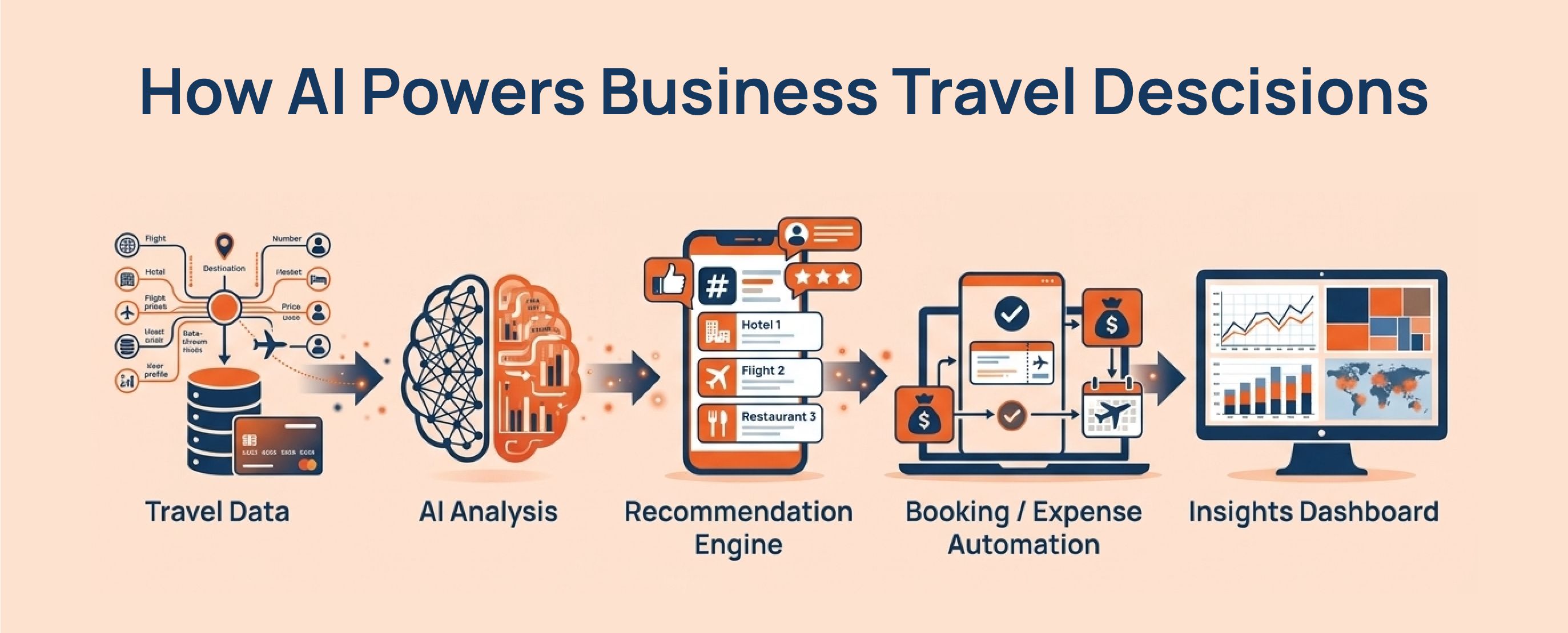
AI analyzes large datasets across travel bookings, expense records, pricing trends, and employee behavior.
Examples include:
- Identifying frequently missed savings opportunities
- Detecting unusual spending patterns
- Recognizing traveler preferences
AI systems can provide instant recommendations at the point of booking or expense submission. Instead of reviewing travel decisions after they occur, organizations can guide travelers toward compliant and cost-effective choices in real time.
3) Automation of Repetitive Processes
Tasks such as receipt matching, expense categorization, itinerary updates, and policy checks can be automated using AI. This reduces administrative workload for finance and travel teams.
4) Predictive and Prescriptive Insights
Advanced AI models can forecast travel costs, recommend optimal booking windows, and identify potential budget overruns.
Another important capability of AI is context-aware recommendations. Instead of presenting travelers with hundreds of booking options, AI can analyze multiple factors simultaneously including:
- Company travel policies
- Historical traveler preferences
- Supplier agreements
- Real-time pricing trends
This capability forms the foundation of AI-powered corporate travel booking systems, which aim to simplify decision-making for employees while maintaining cost control for organizations.
Platforms that combine AI travel analytics with booking workflows allow companies to move from reactive travel management to intelligent travel optimization.
The Business Travel Lifecycle - Where AI Creates Real Impact
To understand where AI delivers value, it helps to view travel management as a complete lifecycle rather than isolated processes.
The business travel lifecycle typically includes five stages:
- Planning and policy design
- Booking and approvals
- Travel execution and disruption management
- Expense capture and reconciliation
- Spend insights and forecasting
Corporate travel programs are evolving as demand for in-person engagement rises alongside cost pressures. According to Deloitte’s corporate travel study, 73% of travel managers expect their companies’ travel spending to grow in 2024, driven largely by client meetings, sales engagements, and industry events. At the same time, organizations face increasing pressure to balance rising travel costs with employee experience. Sustainability goals, and supplier negotiations prompt many companies to adopt more data-driven approaches, including analytics and automation, to improve compliance and optimize travel spending.
Modern travel and expense management platforms increasingly integrate these stages into a single ecosystem where AI can analyze travel data across the entire lifecycle.
AI Use Cases by Business Role
1) AI for Founders, CXOs and Business Owners
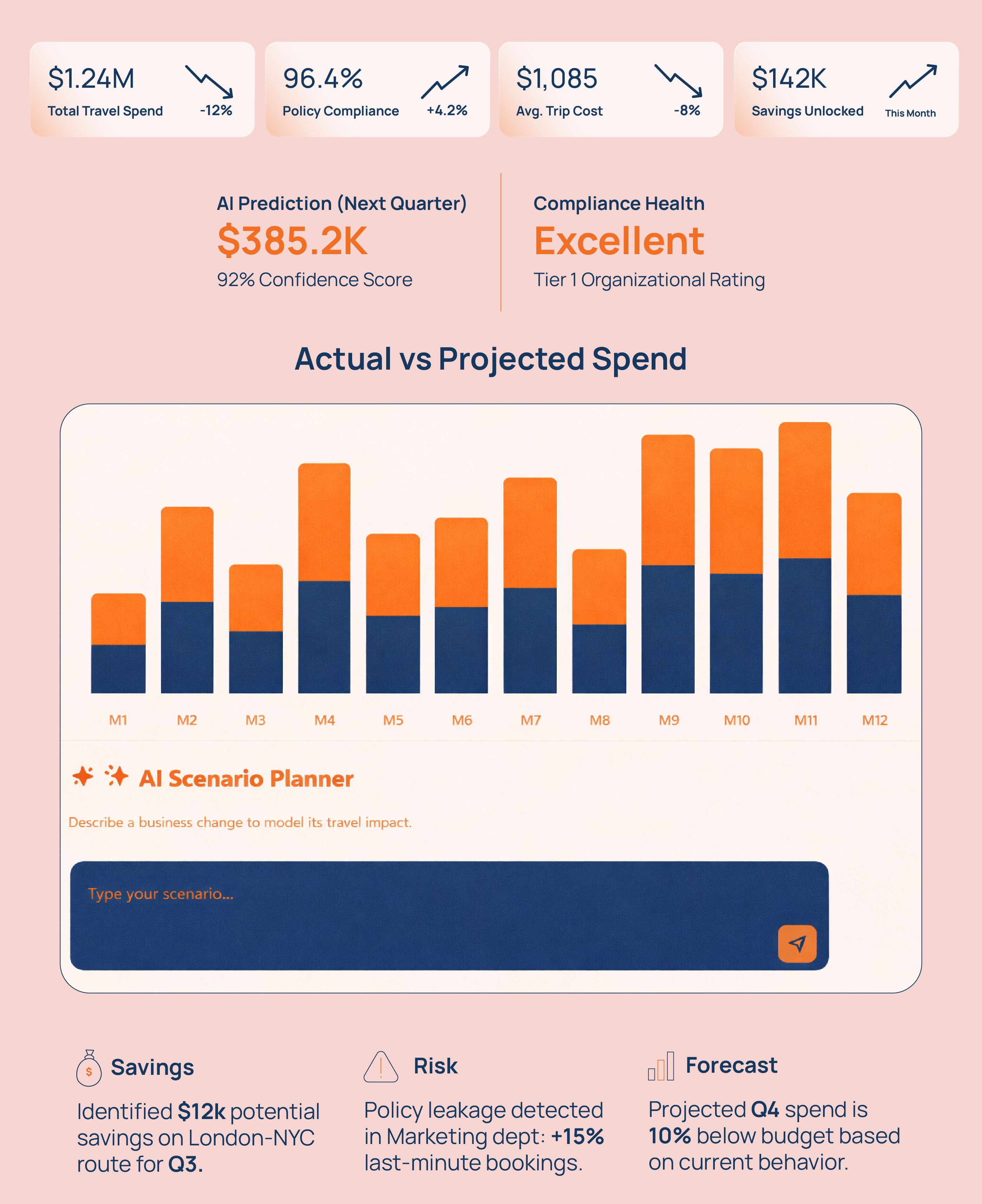
For executive leaders, business travel represents both a strategic investment and a significant operational cost. The key challenge is balancing growth opportunities with financial discipline. AI enables leaders to move beyond traditional reporting and gain real-time visibility into travel performance.
Use Case: Real-Time Travel Spend Visibility
A fast-growing technology company may have employees traveling across multiple regions simultaneously. Traditionally, travel spend reports are generated monthly, meaning executives only see overspending after it occurs.
AI-powered travel analytics platforms can aggregate booking and expense data instantly, allowing leaders to monitor:
- Total travel spend by department
- Cost per trip
- Policy compliance rates
- Regional travel trends
This enables executives to intervene earlier and make proactive budget adjustments.
Use Case: Predictive Budget Forecasting
AI can analyze historical travel patterns and forecast future spending based on:
- Seasonality
- Hiring growth
- New market expansions
- Major events or conferences
This allows leadership teams to model different scenarios such as:
- What happens if travel increases by 15%?
- What cost savings could be achieved with earlier bookings?
The result is forward-looking financial control rather than reactive reporting.
2) AI for Finance Teams
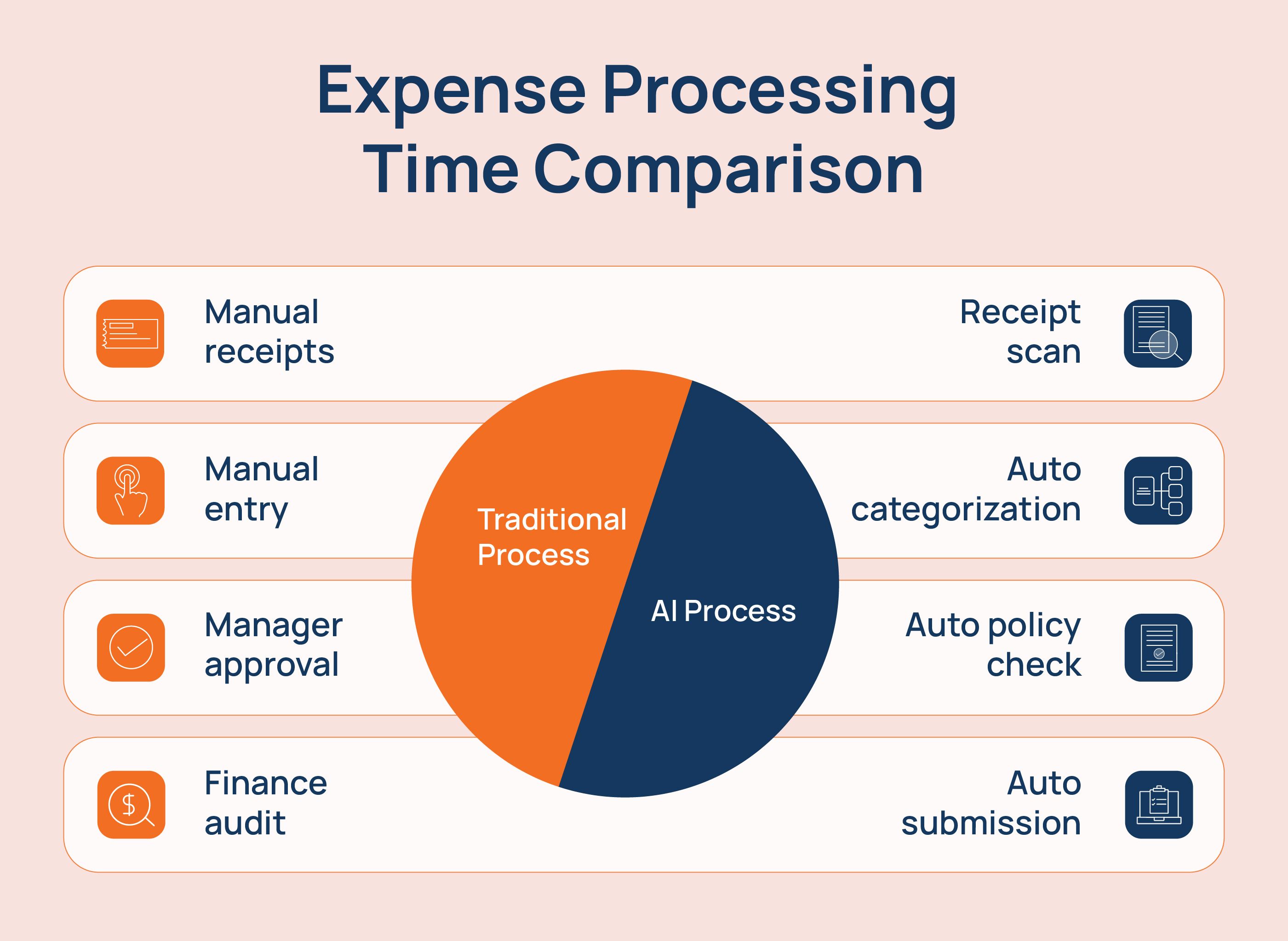
Finance teams are responsible for ensuring travel expenses are accurate, compliant, and auditable. AI-powered expense platforms can automatically match receipts to transactions using machine learning and optical character recognition. Research indicates AI can reduce expense report processing time by up to 72%.
Use Case: Automated Receipt Matching
AI-powered expense systems can automatically extract information from receipts using optical character recognition (OCR) and machine learning. Transactions are automatically matched with:
- Corporate card data
- Itinerary bookings
- Expense categories
This eliminates manual data entry and reduces reporting errors.
Use Case: Fraud and Anomaly Detection
AI can identify unusual expense patterns, such as:
- Duplicate reimbursements
- Unusually high hotel costs
- Repeated policy violations
Instead of manually auditing every report, finance teams can focus only on flagged anomalies.
Finance teams must also manage the growing risk of expense irregularities and financial fraud within corporate spending programs. According to the 2024 ACFE Occupational Fraud: Report to the Nations, organizations globally lose an estimated 5% of their annual revenue to fraud, with total documented losses exceeding $3.1 billion across 1,921 investigated cases worldwide. These findings highlight the scale of financial risk organizations face and underscore the importance of stronger monitoring and controls. As travel spending increases, many companies are adopting AI-powered analytics to detect unusual expense patterns, flag potential policy violations, and strengthen oversight across travel and expense management systems.
AI anomaly detection systems help finance teams identify unusual spending patterns such as duplicate reimbursements or unusually high travel expenses.
3) AI for HR and People Operations
Employee expectations around business travel technology have evolved significantly. According to the Expense Management Trends Survey by Center, 68% of employees say they are either unaware of corporate booking tools or find them cumbersome, while 61% bypass company tools and book travel directly on consumer websites. This highlights a growing demand for intuitive digital platforms that simplify booking, policy compliance, and expense reporting within a single workflow. AI-powered travel platforms embed travel policies directly into the booking workflow.
Use Case: Intelligent Policy Enforcement
Traditional travel policies rely on employees reading and interpreting guidelines. AI-enabled systems embed policies directly into the booking process.
For example, if an employee selects a hotel outside the policy limit, the system automatically recommends compliant alternatives. If the traveler attempts to book a last-minute flight, the system can provide cost comparisons. This ensures policy compliance without creating friction for employees.
Use Case: Travel Safety and Duty of Care
AI can monitor real-time travel conditions such as weather disruptions, geopolitical risks, and flight cancellations. Travel managers and HR teams can quickly identify employees in affected regions and arrange alternative travel plans.
Studies show that AI-enabled duty-of-care systems can reduce response times during travel disruptions from 45 minutes to under 3 minutes. If a traveler selects an option outside policy limits, the system automatically recommends compliant alternatives. AI systems can also monitor global travel disruptions and help HR teams respond faster to traveler safety concerns.
4) AI for Procurement and Travel Managers
Procurement teams use AI-driven travel analytics to strengthen supplier negotiations. AI can evaluate airline and hotel providers based on:
- Cost trends
- Service reliability
- Traveler satisfaction
- Negotiated contract performance
This helps procurement teams identify the most effective supplier partnerships. AI can also detect missed savings opportunities, helping companies identify routes where preferred suppliers could reduce costs.
Use Case: Missed Savings Detection
AI can analyze booking patterns and identify opportunities where earlier bookings or preferred suppliers would have reduced costs. These insights provide procurement teams with stronger data during supplier negotiations.
5) AI for Business Travelers
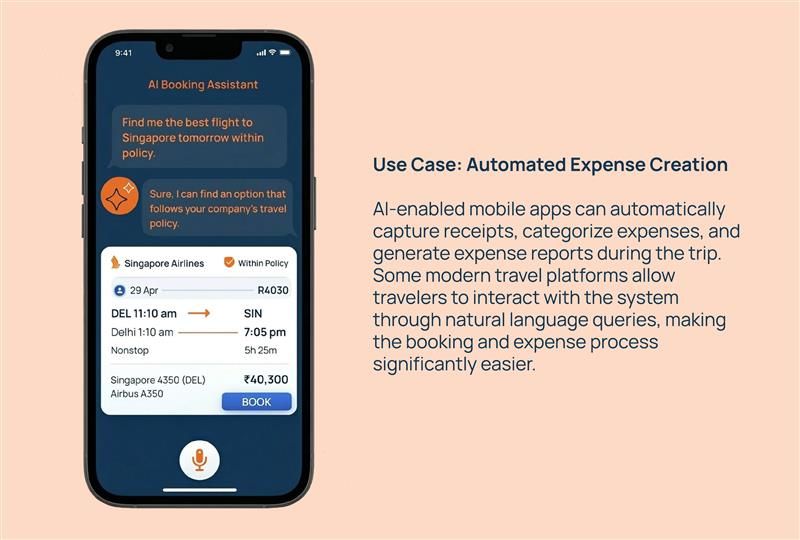
For employees, AI simplifies travel planning. AI-powered travel assistants can:
- Recommend policy-compliant itineraries
- Provide itinerary updates
- Automatically capture receipts
- Generate expense reports
Use Case: Smart Booking Recommendations
When employees search for travel options, AI systems can recommend itineraries that balance price, policy compliance, traveler preferences, schedule efficiency.
Making AI Work Across Teams
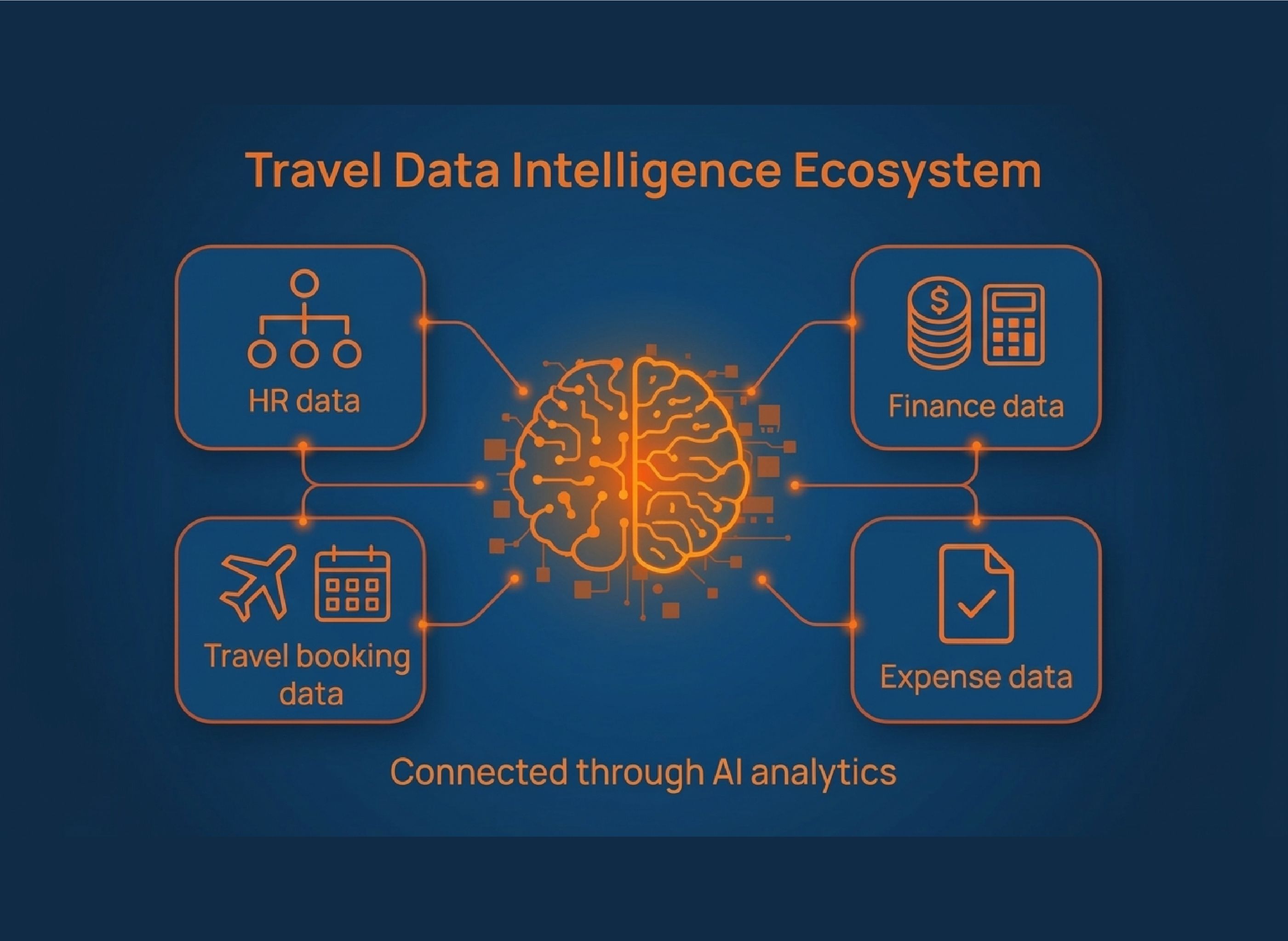
Many organizations operate separate systems for travel booking, expense management, HR approvals, and financial reporting.
When these systems are disconnected, valuable insights are lost.
Unified AI-powered travel and expense platforms allow organizations to analyze travel data across departments, improving collaboration between finance, HR, procurement, and travel management teams.
Security and Risk Considerations
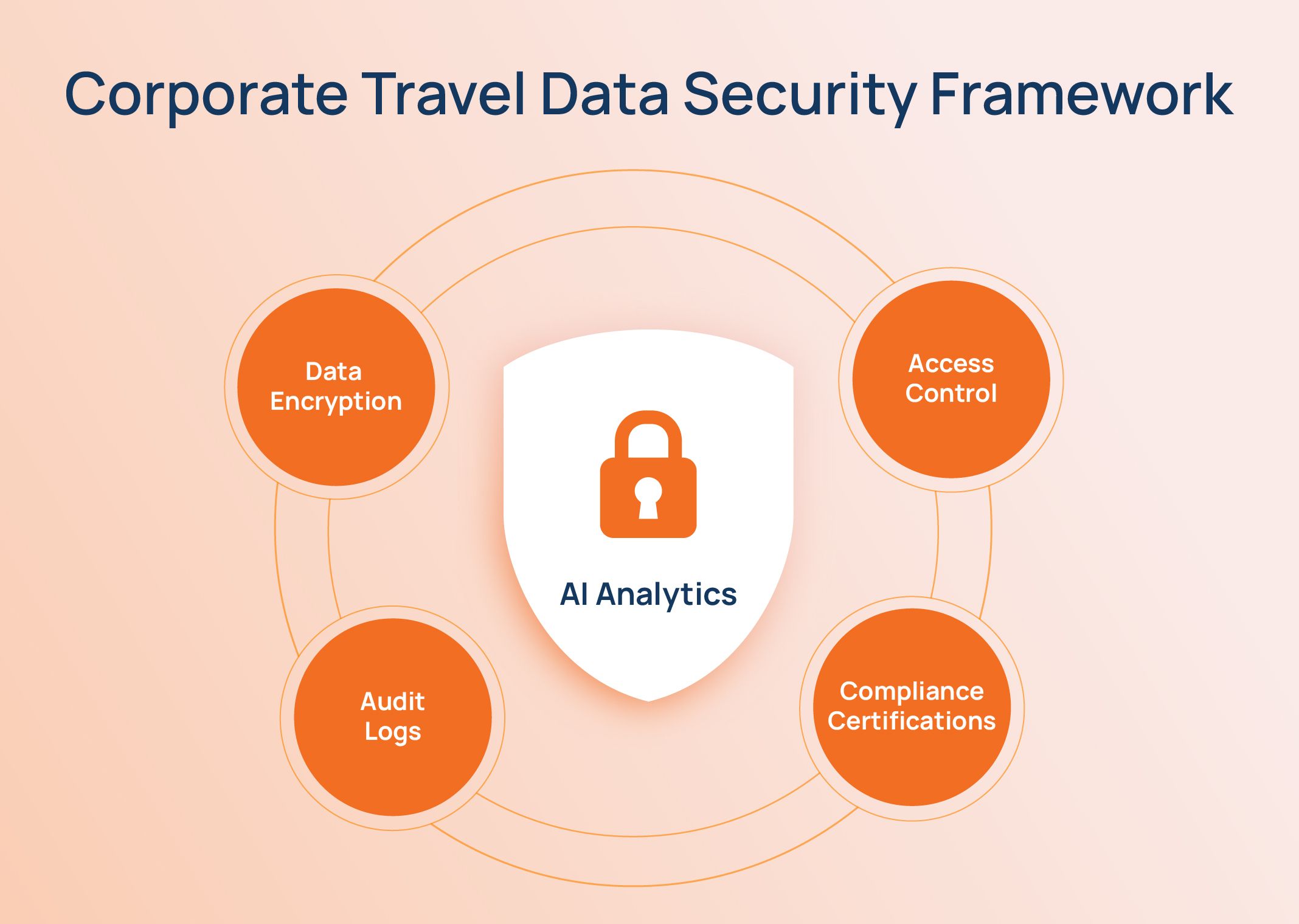
Corporate travel data includes sensitive information such as employee identities, financial transactions, and travel itineraries.
Organizations adopting AI travel platforms should evaluate:
- End-to-end encryption
- Role-based access controls
- Secure API integrations
- Audit trails for financial decisions
Companies should also ensure compliance with international security standards such as:
- ISO 27001
- SOC 2
- GDPR data protection regulations
How to Start Using AI in Business Travel
Organizations do not need to overhaul their travel programs overnight. A practical adoption strategy typically involves three stages.
Step 1: Identify the biggest friction point, which can be -
- Slow expense processing
- Lack of travel spend visibility
- Low policy compliance
Step 2: Implement a focused AI workflow, examples include:
- AI-powered booking recommendations
- Automated expense management
- Predictive travel analytics
Step 3: Integrate systems over time
As AI capabilities expand, organizations can integrate travel booking, expense management, and financial reporting into a unified platform. The impact should be measured using clear metrics such as:
- Cost savings
- Time saved in expense processing
- Compliance rates
- Employee satisfaction
What AI-Mature Business Travel Looks Like
Organizations that successfully adopt AI across their travel programs typically experience several improvements. Travel decisions become data-driven and proactive rather than reactive. Finance teams can monitor travel spend in real time, while employees benefit from faster approvals and simpler expense reporting. AI-mature travel programs demonstrate:
- Real-time spend visibility
- Predictive travel budgeting
- Automated expense processing
- Improved traveler experience
- Higher policy compliance
- Improved supplier negotiation outcomes
- Reduced administrative workload
Travel decisions become proactive rather than reactive, enabling organizations to optimize travel investments.
The Shift from Managing Travel to Managing Outcomes
Traditionally, travel management focused on controlling bookings and enforcing policies.
AI allows organizations to move beyond operational travel management toward strategic travel intelligence. Instead of simply controlling bookings, companies can measure:
- Revenue impact of travel
- Cost efficiency of travel programs
- Productivity outcomes from business trips
Travel becomes a strategic investment rather than just a cost center.
Additional Industry Statistics
Additional statistics reinforce the growing role of AI in business travel management. Studies show that organizations implementing AI-powered travel platforms can achieve return on investment within 4-14 months.
These benefits are one reason why AI adoption in corporate travel management continues to accelerate.

AI Business Travel Maturity Assessment Framework
Organizations typically move through four stages of AI maturity in corporate travel.
Level 1 - Manual Travel Program
Characteristics:
- Manual bookings
- PDF travel policies
- Manual expense reports
Challenges:
- Limited visibility
- Slow financial reporting
Level 2 - Digitized Travel Program
Characteristics:
- Online booking tools
- Digital expense reporting
- Approval workflows
Limitations:
- Limited analytics
- Fragmented systems
Level 3 - Intelligent Travel Program
Capabilities:
- AI travel analytics
- Automated expense categorization
- Policy enforcement during booking
Level 4 - AI-Optimized Travel Program
Capabilities:
- Predictive travel cost forecasting
- Automated travel decision support
- Unified travel data ecosystem
At this stage, travel programs become strategic intelligence systems.
AI Travel Program Self-Assessment Checklist
Organizations can use the following questions to evaluate their current level of maturity.
Visibility
- Do you have real-time visibility into corporate travel spend?
- Can leadership access travel insights instantly?
Compliance
- Are travel policies automatically enforced during booking?
- Can your system detect expense anomalies automatically?
Automation
- Are expense reports generated automatically?
- Are receipts captured and categorized by AI?
Intelligence
- Can you forecast travel spending based on historical trends?
- Does your platform recommend cost-efficient travel options?
Traveler Experience
- Do employees receive personalized travel recommendations?
- Can travelers manage bookings and expenses through a single platform?
Final Thought
Business travel continues to grow globally, creating new opportunities for organizations to expand markets and build partnerships.
However, managing travel effectively at scale requires new capabilities.
Artificial Intelligence provides a powerful framework for transforming travel management by delivering:
- Real-time insights
- Automated processes
- Predictive cost control
- Improved traveler experience
Organizations that adopt AI strategically can unlock significant operational and financial advantages in their travel programs.
FAQ
1) Will AI replace travel managers?
No. AI supports travel managers by automating repetitive tasks and providing data insights.
2) How quickly can companies see ROI from AI travel platforms?
Studies indicate that organizations typically achieve ROI within 4–14 months after implementing AI-driven travel management tools.
3) Is AI safe for managing corporate travel data?
Yes, provided organizations select platforms that meet global security and data protection standards.
Glossary of AI Terms in Business Travel
- Predictive Analytics - using historical travel data to forecast spending trends
- Policy Automation - embedding travel policy rules directly into booking workflows
- Anomaly Detection - AI identifying unusual expense patterns
- Conversational AI - Natural-language interaction with travel platforms

Disha Chatterjee
Senior Content MarketerIn this article
1.Why Business Travel Needs AI Now
2.What ‘AI in Business Travel’ Really Means
3.The Business Travel Lifecycle - Where AI Creates Real Impact
4.AI Use Cases by Business Role
5.Making AI Work Across Teams
6.Security and Risk Considerations
7.How to Start Using AI in Business Travel
8.What AI-Mature Business Travel Looks Like
9.The Shift from Managing Travel to Managing Outcomes
10.AI Business Travel Maturity Assessment Framework
11.AI Travel Program Self-Assessment Checklist
12.Final Thought
13.FAQ
14.Glossary of AI Terms in Business Travel