Your Travel Data Is Talking. Are You Listening?

For most organizations, business travel is still viewed through the lens of cost.
- How much did we spend?
- Did we stay within budget?
- Were employees compliant with policy?
These are important questions. But they are also incomplete.
Because travel is no longer just a line item on a finance report. It is one of the few business functions that touch almost every part of the organization simultaneously. Travel decisions influence procurement outcomes, employee experience, supplier negotiations, risk management, sustainability goals, and financial performance. Every booking, approval, expense claim, reimbursement, cancellation, and policy exception leaves behind a digital trail that reveals how the organization actually operates.
Yet most companies continue to use travel data the way they did ten years ago - as a reporting tool rather than a decision-making tool.
The result is a surprising paradox. Organizations have more visibility into their travel programs than ever before, but many still struggle to answer fundamental questions about why costs are rising, where compliance breaks down, or which travel investments are delivering value. They are collecting enormous amounts of data while extracting very little intelligence from it.
At a time when finance leaders are being asked to do more with less, that represents a missed opportunity.
Travel Data Reveals Costs You Don't Know Exist
Most cost-control initiatives focus on visible expenses. Airfare. Hotels. Ground transportation. Reimbursements.
The larger opportunity often lies in the costs that aren't immediately visible.
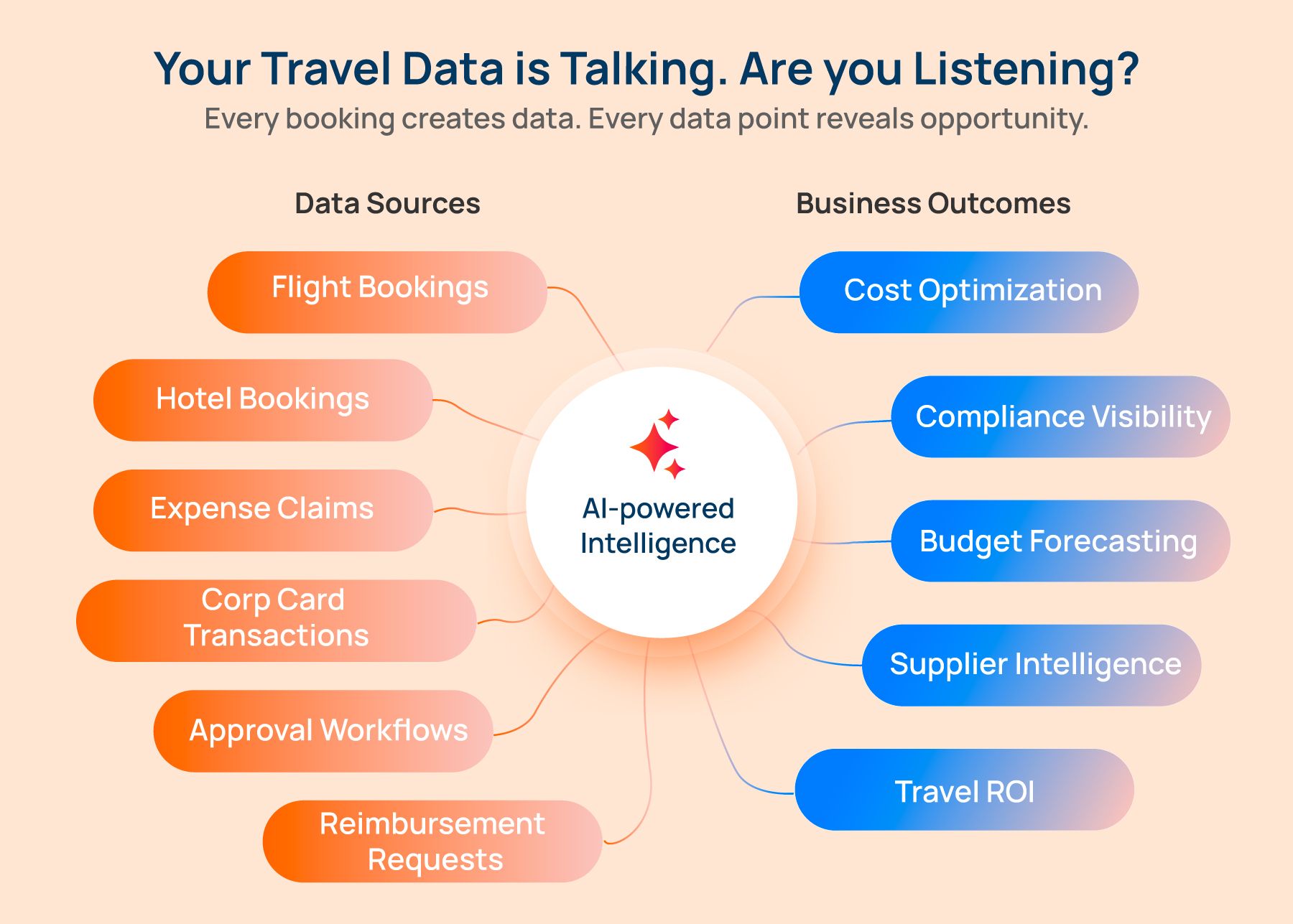 Consider a company that sees travel spend increase by 12% year over year. The instinctive response might be to renegotiate supplier contracts or tighten travel policies. But the real drivers of that increase could be hidden much deeper within the data. Perhaps employees are booking flights closer to departure than they were a year ago. Maybe a growing percentage of bookings are happening outside approved channels. Perhaps certain departments are consistently bypassing negotiated hotel rates.
Without granular visibility, all these scenarios look identical on a quarterly spend report.
The challenge becomes even more significant as travel managers face mounting cost pressures. In Deloitte's 2025 Corporate Travel Study, 54% of travel managers identified rising costs as one of the biggest factors restricting travel, making it the most frequently cited challenge facing corporate travel programs today. At the same time, companies are increasing scrutiny of how travel budgets are allocated and measured.
The most sophisticated organizations are responding by moving beyond spend reporting and focusing on behavioral analysis. They are examining booking patterns, approval cycles, supplier adoption rates, traveler choices, and reimbursement timelines to identify where inefficiencies originate. Instead of asking, “What did we spend?” they are asking, “What caused us to spend this way?”
That distinction changes everything.
Because once organizations understand the behavior behind the spend, they gain the ability to influence outcomes before costs occur rather than explaining them after the fact.
The Future of Travel Management Is Predictive, Not Reactive
For decades, travel management has largely been retrospective.
- A report is generated at the end of the month
- Finance reviews spending
- Travel managers investigate anomalies
- Policies are adjusted
- The cycle repeats
The problem with retrospective management is that the opportunity to act has already passed.
The next generation of travel programs is being built around a different philosophy: prediction rather than reaction.
This shift is already visible across corporate travel. Deloitte's research found that travel buyers are moving away from manually scrutinizing individual trips and toward more strategic oversight models focused on governance, performance, and long-term outcomes. Rather than managing travel one booking at a time, organizations are increasingly looking for ways to identify patterns across thousands of transactions.
The implications are significant.
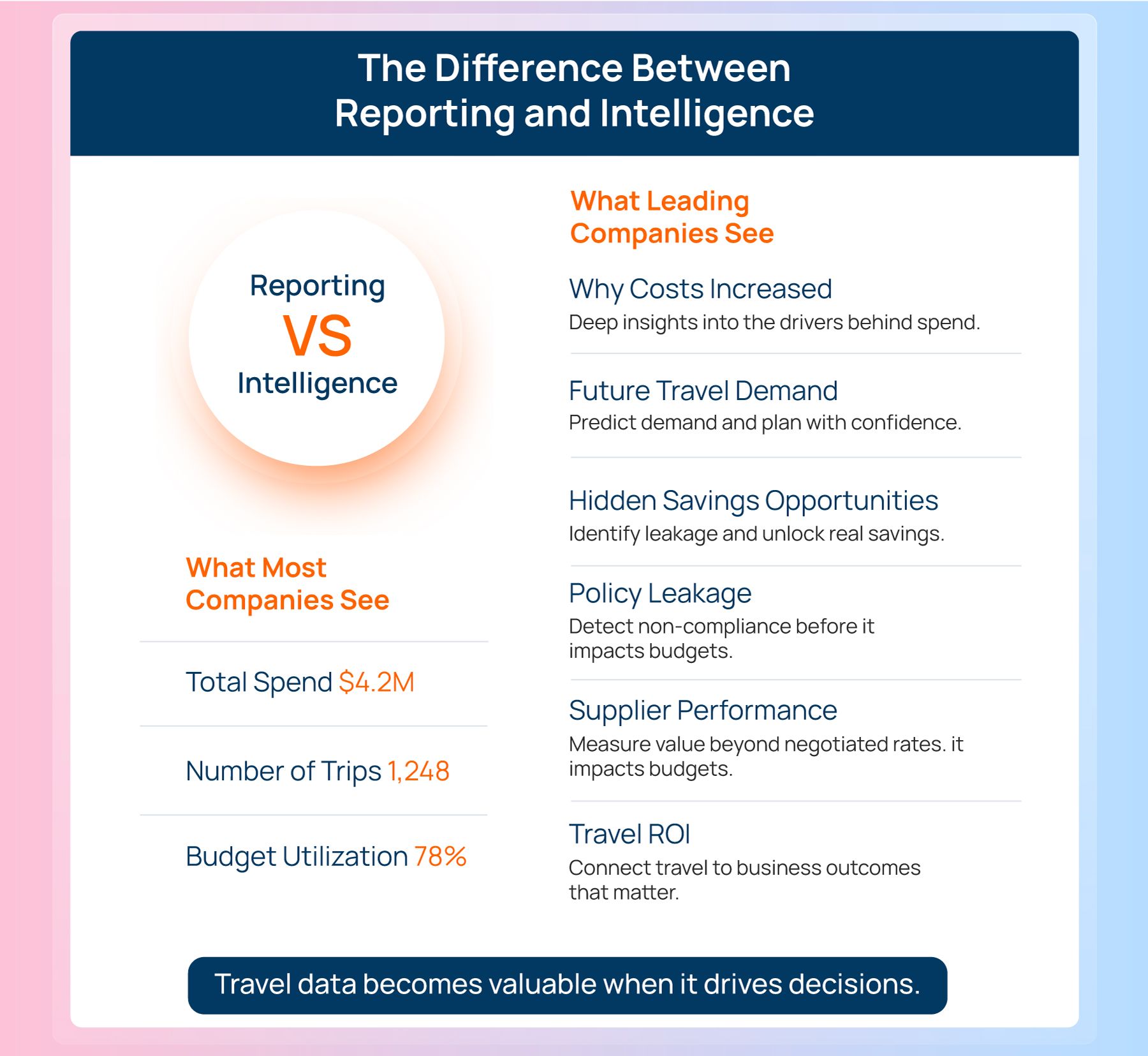
Predictive travel intelligence can identify routes that are becoming unusually expensive before they impact budgets. It can detect emerging patterns of policy non-compliance before they become systemic. It can forecast future travel demand based on historical behavior and business activity. It can even highlight supplier relationships that are underperforming relative to negotiated agreements.
In many ways, travel is following the same evolution that transformed finance, marketing, and supply chain management. The organizations that once relied on reports now rely on intelligence platforms capable of surfacing risks and opportunities automatically.
Travel is beginning to follow the same path.
And as artificial intelligence becomes increasingly embedded in business operations, the expectation will no longer be that leaders discover insights themselves. The expectation will be that the system identifies them first.
The future travel manager may spend less time producing reports and more time acting on recommendations generated from the data already flowing through the organization.
Travel Data Is Becoming a Boardroom Conversation
Historically, travel management lived within procurement, administration, or operations.
Today, it is attracting attention from a much broader group of stakeholders.
- Finance leaders want greater visibility into spend
- Procurement teams want stronger supplier leverage
- HR leaders care about employee experience
- Risk teams need accurate traveler tracking and duty-of-care visibility
- Sustainability leaders want reliable emissions reporting
What connects all these priorities is data.
Travel data has become one of the few datasets capable of providing insight across multiple business functions simultaneously. It reveals where people are going, why they are traveling, how money is being spent, whether policies are being followed, and how business priorities are evolving.
This growing strategic importance is reflected in how organizations are approaching travel governance. Deloitte's latest research shows that C-suite involvement in travel strategy remains high, while organizations increasingly attach business outcomes and performance measures to travel spending decisions. Travel is no longer being evaluated solely as a cost of doing business; it is increasingly being assessed as an investment expected to generate measurable value.
That shift matters.
When travel becomes a boardroom discussion rather than an operational discussion, the quality of data becomes a competitive advantage.
Organizations with fragmented booking systems, disconnected expense processes, and incomplete visibility struggle to answer increasingly important questions. Organizations with unified travel and expense data can move from assumptions to evidence.
They can negotiate with suppliers from a position of knowledge rather than estimates. They can justify budgets with confidence. They can connect travel decisions to broader business outcomes.
Most importantly, they can make faster decisions in a business environment where speed increasingly matters.
The Organizations That Listen Will Win
![3] 1.jpg](https://websiteadmin.tripgain.com/uploads/3_1_7abb7422ed.jpg)
The conversation around business travel often focuses on costs, compliance, and control.
Those issues matter. But they are becoming table stakes.
The real opportunity lies in understanding what travel data reveals about the business itself. Because travel data is not really about flights, hotels, or expense claims. It is about behavior.
It tells you how employees work, how departments collaborate, how budgets are managed, where inefficiencies emerge, and where opportunities exist.
The companies that gain the greatest value from business travel over the next decade will not necessarily be the ones with the lowest travel spend or the strictest policies.
They will be the ones that learn how to listen - not to their travelers, not to their suppliers - but to the data their travel programs have been generating all along.
Because every trip tells a story. And the organizations paying attention are already hearing it.

Disha Chatterjee
Senior Content MarketerIn this article
1.Travel Data Reveals Costs You Don't Know Exist
2.The Future of Travel Management Is Predictive, Not Reactive
3.Travel Data Is Becoming a Boardroom Conversation
4.The Organizations That Listen Will Win

Related Blogs