Your Finance Team Runs on WhatsApp. That's Not a Flex.

A love letter to every CFO who has ever said "just send it to me on WhatsApp" and then lost the invoice forever.
There's a ritual in almost every company. It happens every month, reliably, like the IPL schedule or your uncle's unsolicited career advice at family dinners.
It goes like this.
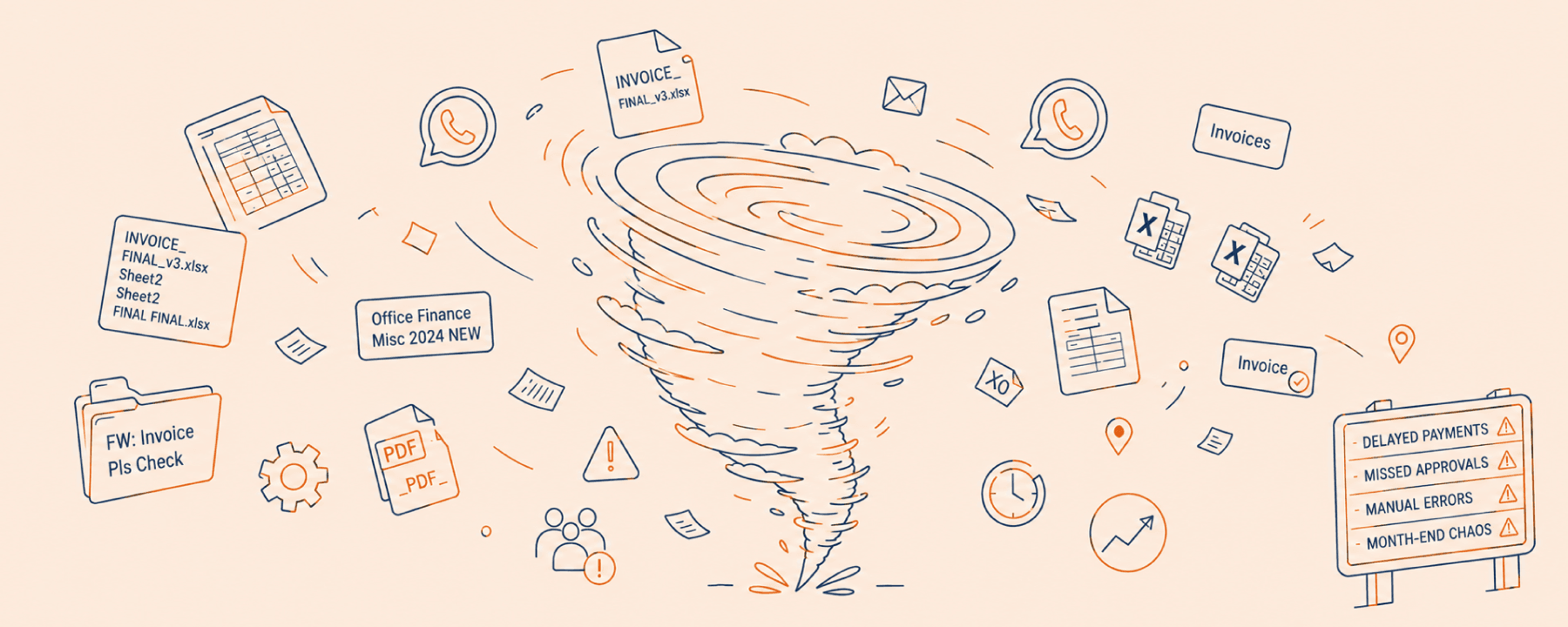
A vendor sends an invoice. The invoice lands in someone's email - let's call her Priya. Priya is not the right person. Priya forwards it to Rahul. Rahul is also not the right person, but Rahul is very confident, so he sends it to the Finance Manager on WhatsApp with a cheerful "Hey, please handle." The Finance Manager sees it, thinks he'll deal with it later, and then proceeds to forget about it entirely because he has 47 other unread messages from 6 different vendor groups.
Three weeks later, the vendor calls. The Finance Manager has no idea what invoice they're talking about. Priya has deleted her chat history to free up phone storage. Rahul has left the company.
And somewhere, in a WhatsApp group called "Office Finance Misc 2024 NEW," the invoice sits. Unread. Collecting digital dust.
This is the state of vendor expense management at most companies. And honestly? It's not anyone's fault. We built our processes around the tools we had. And the tools we had were WhatsApp, Excel, and the eternal human will to just figure it out somehow.
The technical term for this is jugaad. The finance term is a complete disaster.
The Excel That Ate The Finance Team
Let me paint you a picture of a typical finance team's month-end.
It's the 28th. The team has a master Excel sheet. It has 14 tabs. Three of them are labelled "FINAL," one is labelled "FINAL FINAL," and one is labelled "USE THIS ONE - RAHUL DON'T TOUCH." Nobody knows which one is current. Rahul has touched all of them.
Every vendor invoice has been manually typed in - vendor name, amount, tax breakup, invoice number, payment date. Some entries have comments like "paid? check with accounts." Some have no amount because "the invoice was blurry." One entry just says "Pune trip?" with no further context.
Meanwhile, someone in the approval chain has been on leave since the 20th. Their replacement is approving things they don't fully understand, because the alternative is a very uncomfortable conversation with the CFO at month-end.
The CFO, for their part, is running on three cups of chai and the vague feeling that something is wrong but they can't prove it yet.
This is not a finance problem. This is a workflow problem. The finance team is not bad at their jobs - they're actually exceptional at working around systems that were never designed for the volume and complexity of what they handle.
The Three Villains of Vendor Invoice Processing
If you want to understand why vendor expense management is such a mess, you need to understand the three characters who make it that way.
The Approval Bottleneck: Every company has one person without whom nothing can move. They're always in a meeting. Their out-of-office is permanently on. Invoices queue up waiting for their sign-off the way people queue up for Diljit Dosanjh concert tickets - desperately, with no guarantee of success.
The Data Entry Loop: Someone uploads the invoice. Someone else re-types the information from the invoice. Then someone double-checks the re-typed information against the original invoice. This is the finance equivalent of writing something on paper, photographing the paper, printing the photograph, and then scanning the print. It makes no sense, but it's Tuesday, so here we are.
The Reconciliation Reckoning: Month-end is when all sins are accounted for. Every invoice that got lost in a WhatsApp thread, every payment that went out but wasn't logged, every vendor entry that didn't make it into the ERP, it all surfaces here. At 11 PM. When everyone wants to go home.
What Automation Actually Means (No, Not AI Taking Your Job)
Here's what people get wrong about automating finance processes: they think it means replacing people. It doesn't. It means replacing the parts of the job that are actively making people miserable.
Nobody went to CA school dreaming of manually entering tax numbers into a spreadsheet. Nobody's career goal was "forward invoices on WhatsApp and hope for the best." These are the parts of the job that eat hours, create errors, and slowly make very smart finance professionals feel like they're running on a treadmill.
What automation does is take the process, the actual movement of an invoice from submission to payment - and make it run without anyone having to push it.
Here's what that looks like in practice.
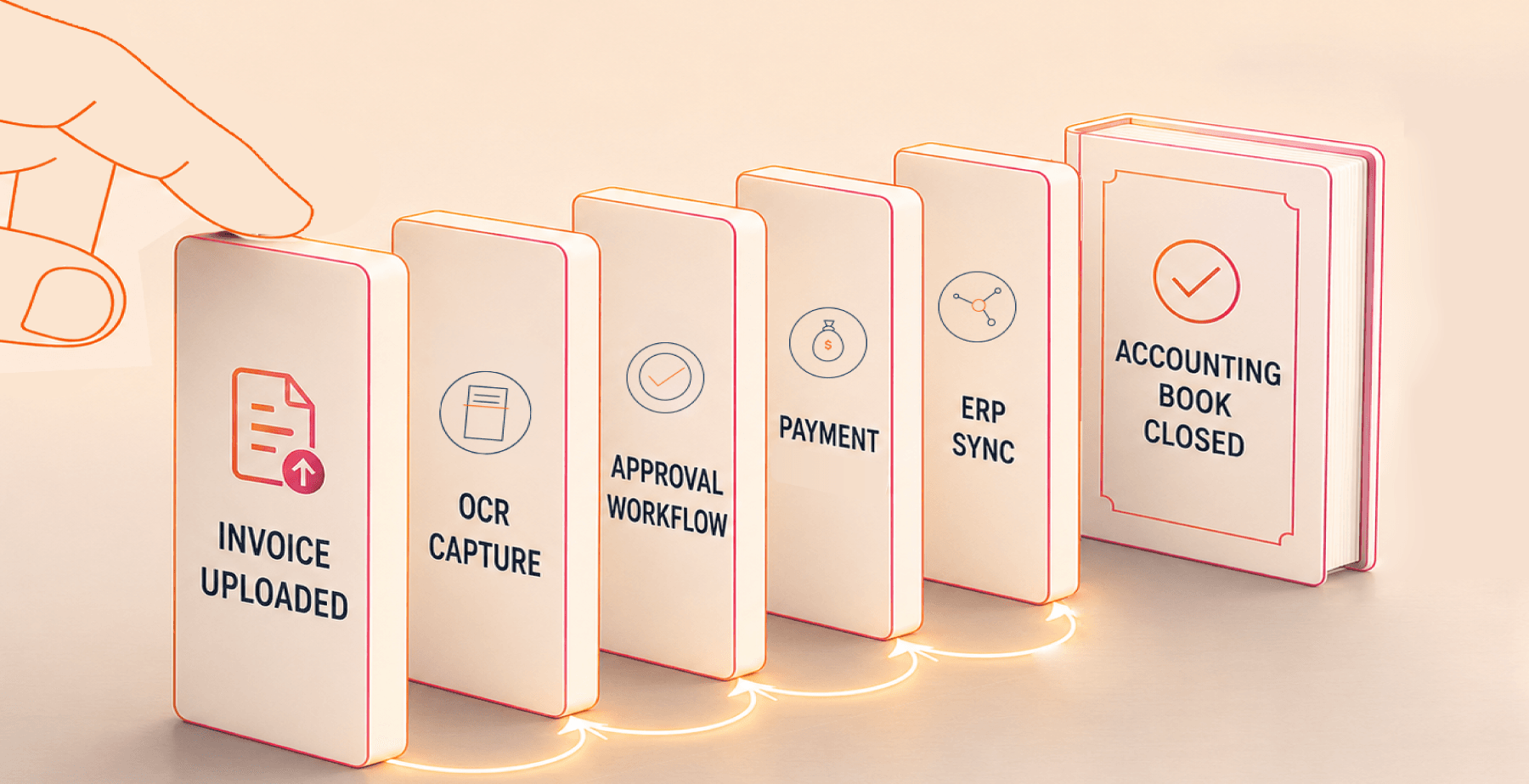
Someone uploads a vendor invoice into TripGain. The system reads it - OCR pulls out the vendor name, invoice number, amount, tax, all of it. No manual typing. The form is already filled. The person just confirms and submits.
The system knows - based on rules you've set - who needs to approve this. Is it a vendor above a certain amount? Goes to the CFO. Specific category like travel or IT? Routes accordingly. Multi-level approval? Each person gets notified in sequence. No one has to chase anyone. No WhatsApp message needed.
Once approved, the Finance Admin reviews it, clicks Reimburse, and TripGain initiates the payment directly to the vendor's bank account via Razorpay. NEFT, IMPS, UPI - whatever works. The vendor gets paid. The entry posts to your ERP automatically. Clean, verified, fully mapped to your ERP codes.
The Finance Manager gets to actually manage. The CFO gets visibility. The vendor gets paid on time, which is genuinely rare enough that they will probably thank you.
And Rahul? Rahul can touch whatever he wants. There's nothing left to break.
Why This Matters More Than You Think
Companies are sitting on a hidden productivity drain that nobody talks about because it's always been this way.
A mid-sized company processing 200-300 vendor invoices a month is spending somewhere between 40-80 hours a month on manual steps that could be automated. That's two full working weeks - per month - on data entry, approval chasing, payment initiation, and reconciliation.
That's time that could go into vendor negotiations, cash flow forecasting, spend analysis, or - and this is radical, actually going home on time.
The tax era forced finance teams to get more rigorous about documentation. UPI forced everyone to get comfortable with digital payments overnight. The next shift is in how invoices move internally - from the moment they arrive to the moment they're paid and recorded.
The companies that figure this out first will have a finance function that scales without linearly adding headcount. That's a real competitive advantage, even if it doesn't feel like one because it's happening in the back office where nobody's writing LinkedIn posts about it.
The Bottom Line
Vendor expense management is not glamorous. There are no TED Talks about invoice routing. Nobody puts "optimised AP workflow" in their bio.
But it is the difference between a finance team that's constantly firefighting and one that actually has time to think.
If your current process involves WhatsApp, a shared Excel with too many tabs, and at least one person whose approval you're perpetually waiting on - you already know something needs to change. You've known for a while. You've just been too busy managing the chaos to fix it.
This is the fix.
In this article
1.The Excel That Ate The Finance Team
2.The Three Villains of Vendor Invoice Processing
3.What Automation Actually Means (No, Not AI Taking Your Job)
4.Why This Matters More Than You Think
5.The Bottom Line

Related Blogs