Why Web Check-In for Flights Still Gets Missed - And What It Reveals About Modern Travel

There’s a familiar moment that continues to play out at airports across the world - a traveler reaches the counter, documents ready, expecting a smooth process, only to be asked, “Have you completed your web check-in?”
And despite years of digital advancement, the answer is still often no.
This isn’t an edge case. It’s a pattern - one that persists even as airlines and airports continue to invest heavily in digital passenger experiences. Which raises a deeper question - if web check-in is simple, widely available, and clearly beneficial, why does it still get missed?
The answer lies not in technology, but in behavior.
The Industry Has Already Moved to Digital
Over the last decade, the aviation industry has aggressively pushed toward digitization - from booking and payments to boarding and baggage tracking.
According to the International Air Transport Association, passenger behavior has shifted significantly toward mobile-first travel. In its latest findings, travelers increasingly expect to manage their entire journey digitally, with smartphones becoming central to everything from booking to check-in and boarding.
In fact, 78% of passengers want a single digital interface to manage travel end-to-end, reflecting a clear demand for seamless, connected experiences (source).
At the same time, industry reports continue to highlight that speed and convenience are the top priorities for travelers, with growing openness to completing processes before reaching the airport.
On paper, web check-in fits perfectly into this shift. And yet, in practice, it continues to be missed.
The Problem Isn’t Adoption. It’s Timing.
Web check-in is not a complex feature. It is widely understood, frequently prompted, and relatively quick to complete.
But it operates within a narrow and inconvenient window, typically 24 to 48 hours before departure. That window rarely aligns with user intent.
For business travelers especially, this period is often consumed by closing loops - final meetings, shifting priorities, and last-minute planning. Check-in doesn’t happen when the trip is being booked, and it doesn’t happen when the traveler is physically at the airport.
It sits in between and that’s where it gets lost.
A Classic Case of Behavioral Friction
From a behavioral standpoint, web check-in suffers from a well-known problem: delayed-action dependency.
Tasks that are not immediately urgent, require a return to a platform, and sit outside the primary workflow are far more likely to be postponed or missed.
Web check-in checks all three boxes.
This is not a failure of awareness. Airlines send reminders. Notifications are triggered. The intent exists. But intent doesn’t always translate into action, especially when timing and context are misaligned.
Why This ‘Small Miss’ Actually Matters
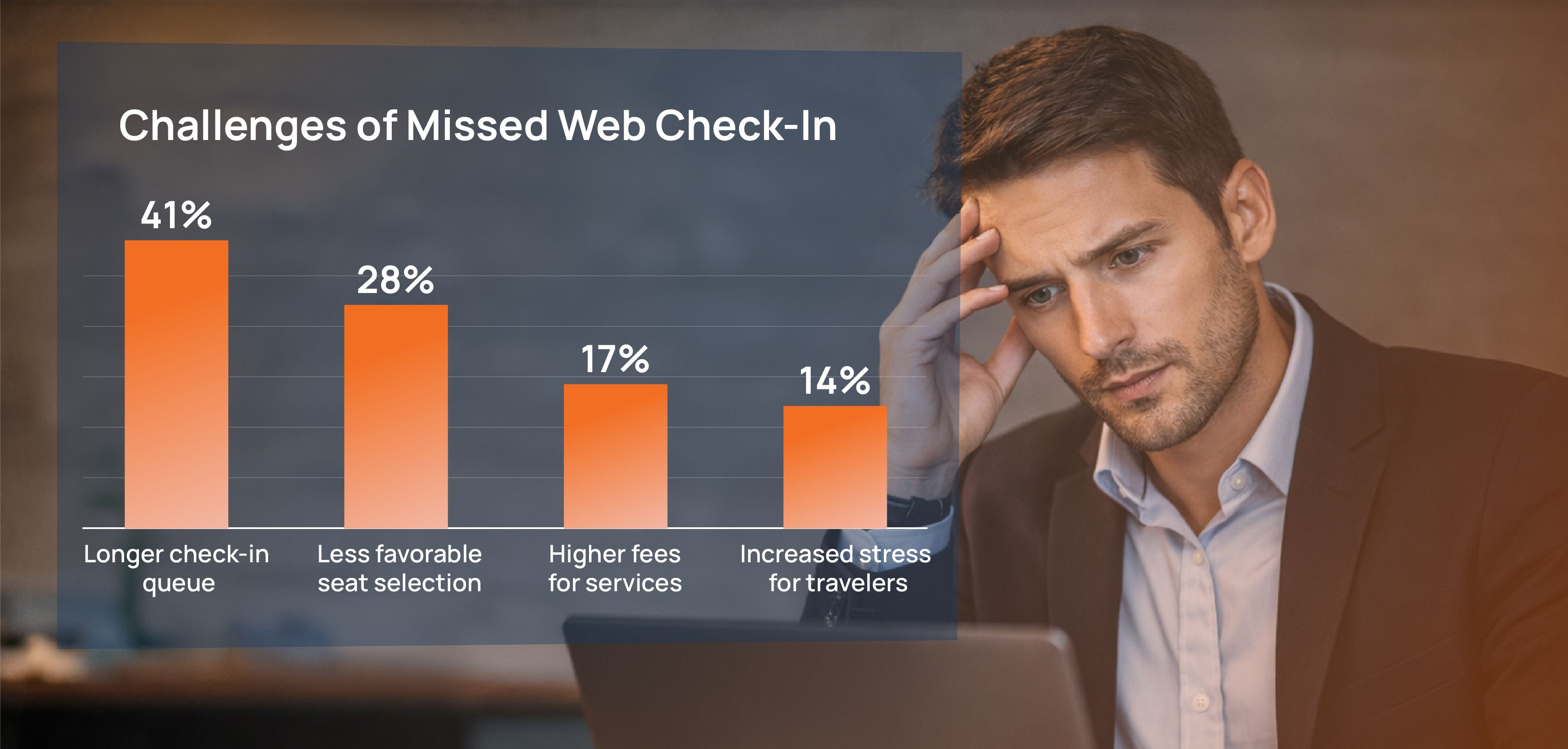
At first glance, missing web check-in seems minor. Travelers can still check in at the airport, and the journey continues. But the downstream impact is more meaningful than it appears.
Airport check-in introduces variability - longer queues, reduced seat availability, and tighter boarding timelines. During peak travel periods, this can create measurable inefficiencies.
From an industry perspective, this also contradicts the very purpose of digitization. Airlines are investing in off-airport processes to reduce congestion and improve throughput. Every missed web check-in pushes demand back toward manual counters. At scale, especially in corporate travel environments, these micro-frictions compound - affecting time, cost, and traveler experience.
A Fragmented Journey in a Connected World
One of the biggest paradoxes in modern travel is, ‘everything is digital, but not everything is connected’.
You can book flights in minutes, access itineraries instantly, track expenses in real time.
But key steps like web check-in still exist as standalone actions. They require separate attention, separate timing, and separate execution. And every additional step increases the chances of friction.
The shift now is not toward more digital tools, but toward fewer disconnected actions.
What Needs to Change
Web check-in doesn’t need reinvention. It needs integration. The current model assumes that travelers will remember, the timing will be convenient, the action will be completed manually. But as the rest of the travel ecosystem moves toward automation and intelligence, this assumption becomes increasingly fragile.
The real opportunity lies in removing the dependency on memory altogether.
Closing the Gap
Web check-in was designed to simplify travel. But its reliance on timing and manual action continues to limit its effectiveness.
This is exactly the gap platforms like TripGain are beginning to address - by enabling automatic web check-in, where the process is completed without requiring travelers to track windows or revisit airline platforms.
It’s not about adding another feature. It’s about removing a step.
Final Thoughts
The future of business travel will not be defined by how many digital features exist.
It will be defined by how seamlessly those features work together and how little they demand from the traveler.
Web check-in solved an operational challenge for airlines. The next step is solving the behavioral challenge for travelers. Because in a world moving toward automation, convenience is no longer about doing things faster.
It is about not having to think about them at all.

Disha Chatterjee
Senior Content MarketerIn this article
1.The Industry Has Already Moved to Digital
2.The Problem Isn’t Adoption. It’s Timing.
3.A Classic Case of Behavioral Friction
4.Why This ‘Small Miss’ Actually Matters
5.A Fragmented Journey in a Connected World
6.What Needs to Change
7.Closing the Gap
8.Final Thoughts

Related Blogs