Why Open Architecture Is Shaping the Future of Travel Technology

Business travel is entering a new era.
AI is transforming how employees book trips. Finance teams expect real-time visibility into spend. Procurement wants greater supplier flexibility. IT leaders are focused on integration, security, and scalability.
Yet many travel programs are still built on technology that was never designed for this level of connectivity.
The challenge isn't a lack of innovation. It's a lack of interoperability.
As enterprises modernize their technology stacks, one principle is emerging as a competitive advantage - open architecture.
Business Travel Is No Longer a Standalone Function
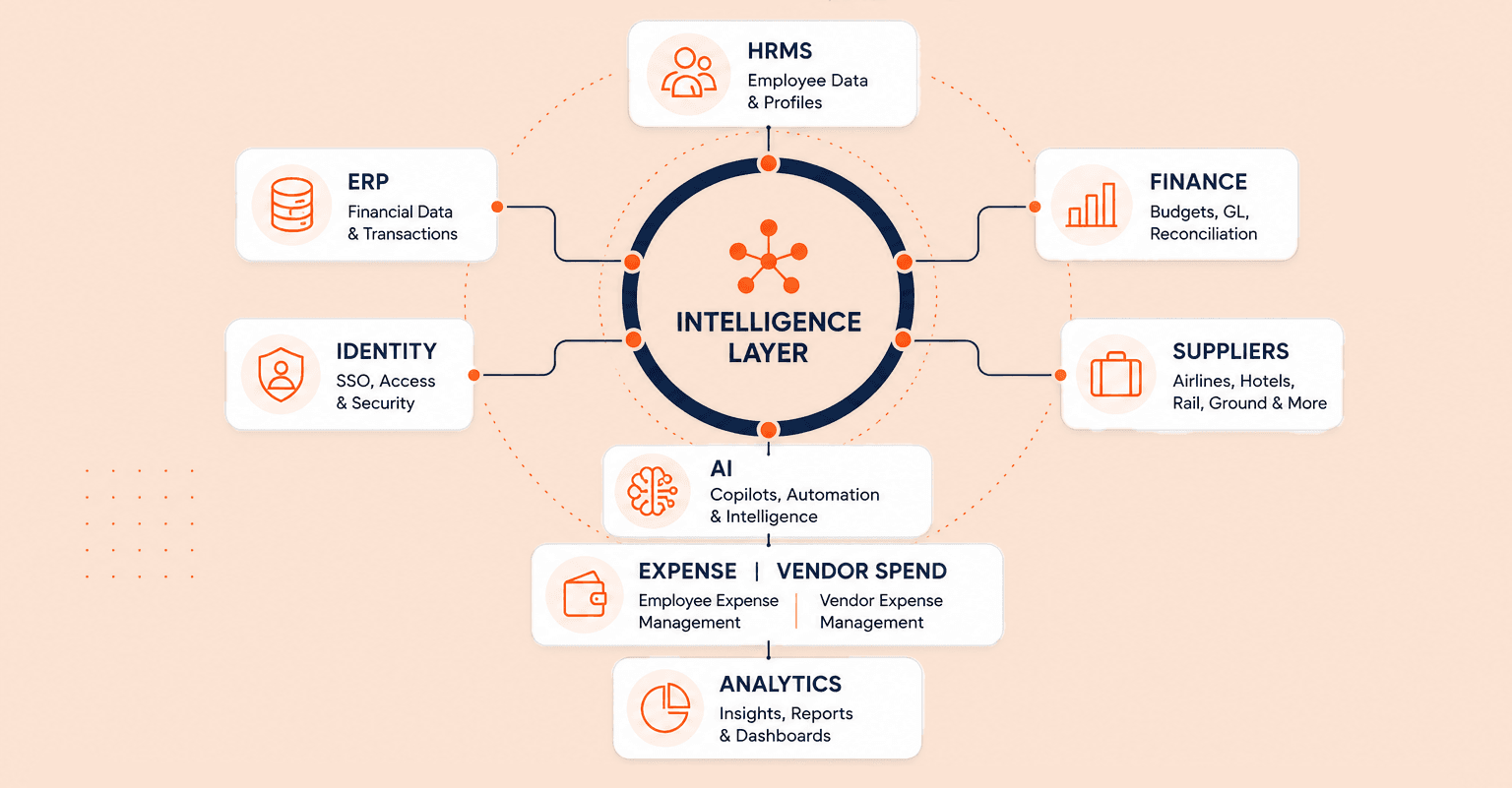
Travel no longer operates in isolation. A single business trip touches multiple enterprise systems:
- HR platforms for employee data
- ERP systems for financial reconciliation
- Expense management for reimbursements
- Procurement for vendor payments
- Identity platforms for secure access
- Finance systems for budgeting and reporting
Every disconnected workflow introduces delays, manual effort, duplicate data, and compliance risks.
Business travel has entered a new phase of growth. According to GBTA Business Travel Index Outlook, 80% of business travelers now travel as much as or more than they did before the pandemic. As travel programs expand, organizations need more than traditional booking tools. They need connected, enterprise-ready technology that can scale with growing demand, streamline operations, and provide the visibility and intelligence required to manage increasingly complex travel ecosystems.
Growth without connectivity, however, creates complexity. That's why enterprises are moving beyond isolated applications toward connected technology ecosystems.
Open Architecture Is More Than APIs
When people hear ‘open architecture’, they often think about APIs.
APIs are only one part of the equation. True open architecture is about creating technology that can connect people, platforms, suppliers, and data without forcing organizations into closed ecosystems.
It enables businesses to:
- Integrate with existing enterprise systems
- Connect multiple travel suppliers
- Exchange data securely across platforms
- Adopt new technologies without replacing existing infrastructure
- Scale as business needs evolve
In other words, open architecture gives organizations freedom to innovate, choose, and adapt.
Why Vendor Lock-In Is Becoming a Business Risk
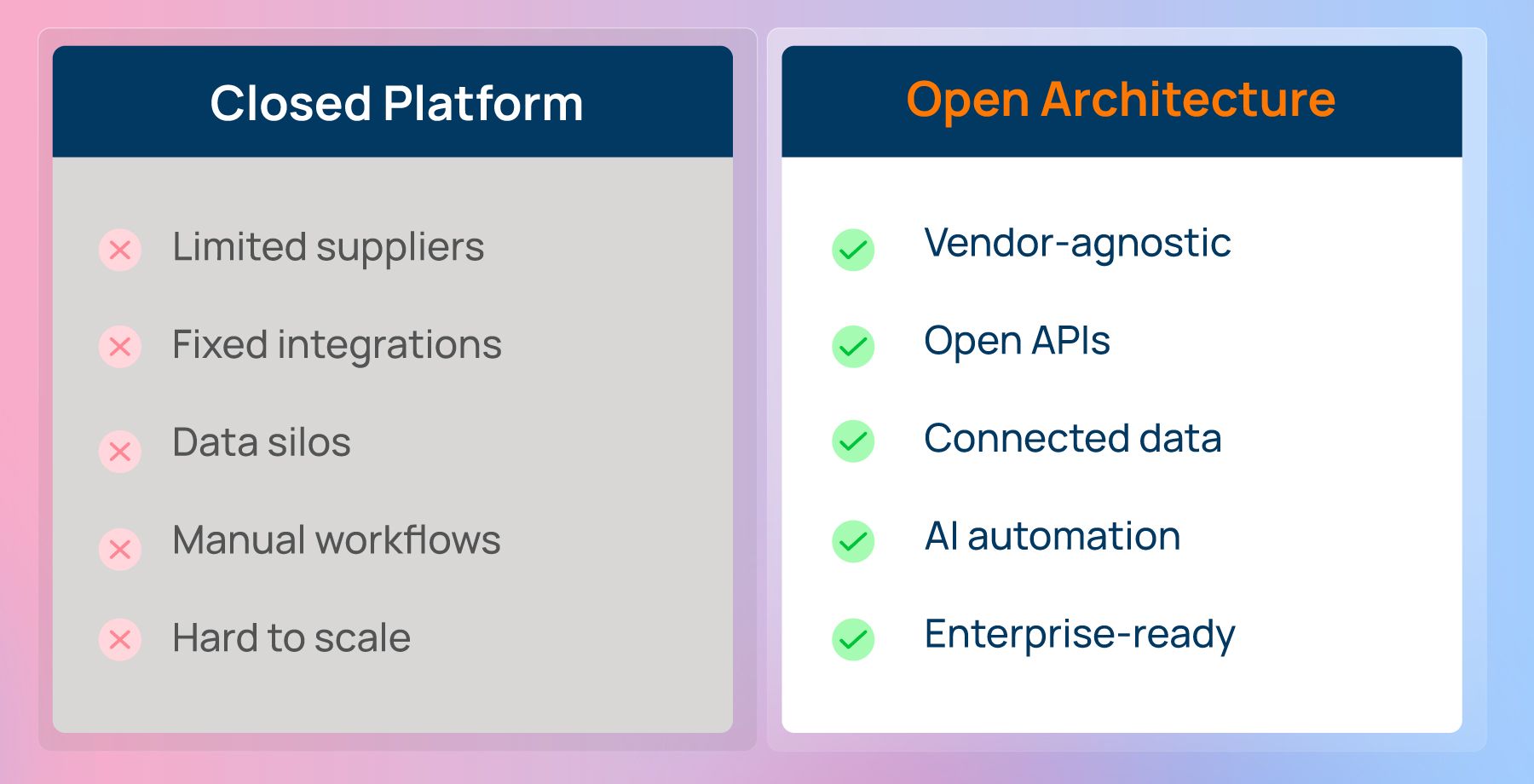
Many organizations still rely on travel ecosystems tied to a limited set of suppliers or proprietary technology.
While these models simplify implementation, they often reduce flexibility over time.
As travel programs expand across regions and business units, organizations need access to different airlines, hotels, rail providers, ground transportation partners, and regional suppliers.
An open, vendor-agnostic architecture allows enterprises to select the right suppliers for each market instead of being constrained by a single ecosystem. The result is greater choice, better commercial flexibility, and stronger long-term resilience.
AI Is Only as Good as the Data It Can Access
The conversation around AI often focuses on chat interfaces and copilots. But AI doesn't create value in isolation. It depends on connected data.
An AI assistant cannot recommend the best itinerary if it cannot access supplier inventory.
It cannot analyze spend if expense data lives in another system. It cannot automate approvals if policies exist elsewhere.
The next generation of enterprise AI will depend less on model capability and more on connected enterprise architecture.
Industry research is moving in the same direction. The OpenAPI Initiative notes that delivering seamless, end-to-end travel experiences requires far greater interoperability between travel providers and technology platforms than legacy systems were designed to support.
The future of travel AI isn't just conversational. It's connected.
Integration Is Becoming a Strategic Advantage
Today's enterprise technology decisions are increasingly evaluated on one question, ‘Will this work with the rest of our business?’
Travel platforms are no exception. Organizations expect seamless integration with:
- ERP platforms
- HRMS
- Accounting software
- Payroll systems
- Identity and SSO
- Business intelligence tools
- Corporate card programs
- Supplier networks
Technology that connects effortlessly reduces implementation effort, minimizes manual work, and creates a single source of truth across the organization. For IT teams, that means less maintenance. For finance, cleaner data. For employees, a better experience.
The Shift from Applications to Platforms
Perhaps the biggest transformation happening in enterprise travel isn't AI. It's platform thinking.
Instead of deploying separate applications for booking, expenses, vendor invoices, approvals, analytics, and reporting, organizations are looking for connected platforms that orchestrate the entire travel and spend lifecycle.
This shift enables:
- Better policy compliance
- Faster decision-making
- Reduced operational complexity
- Greater spend visibility
- Enterprise-wide intelligence
Travel technology is no longer just supporting travel. It's supporting business operations.
What This Means for Enterprise Leaders
When evaluating travel technology, the conversation should extend beyond features.
Questions worth asking include:
- Can the platform integrate with our existing technology stack?
- Does it support a vendor-agnostic ecosystem?
- Can it scale as our business grows?
- Is it built for AI-driven workflows?
- Will it adapt to future enterprise technologies?
These questions will increasingly determine whether a travel platform becomes a long-term strategic asset or another disconnected system.
The Road Ahead
Enterprise travel is becoming more intelligent, more connected, and more autonomous. Open architecture is what makes that transformation possible. Organizations that embrace connected ecosystems today will be better positioned to adopt AI, integrate emerging technologies, and respond quickly as business needs evolve. The future of travel technology won't be defined by who offers the most features. It will be defined by who builds the most connected platform.
Final Thoughts
At TripGain, we've always believed that enterprise travel technology should fit into your business, not force your business to fit into the technology.
That's why we've built an AI-native, vendor-agnostic platform with open connectivity at its core, enabling organizations to unify travel, employee expenses, vendor expense management, and enterprise intelligence within a connected ecosystem.
Because the future of business travel isn't built on isolated applications. It's built on open architecture.

Disha Chatterjee
Senior Content MarketerIn this article
1.Business Travel Is No Longer a Standalone Function
2.Open Architecture Is More Than APIs
3.Why Vendor Lock-In Is Becoming a Business Risk
4.AI Is Only as Good as the Data It Can Access
5.Integration Is Becoming a Strategic Advantage
6.What This Means for Enterprise Leaders
7.The Road Ahead
8.Final Thoughts

Related Blogs