Why Corporate Travel Management Is Costing Your Company More Than You Think
There's a number your company doesn't know.
It's not in your Tally. It's not in any report. Your CFO hasn't asked for it because they don't know it exists.
It's the real cost of how your company manages business travel.
Not just the flight tickets and hotel bills. The other stuff. The stuff that doesn't show up anywhere because it's hiding inside people's time, people's emails, and one very important WhatsApp group that nobody can find anymore.
If someone asked you right now, "What did your company spend on travel last month?" you'd probably say something like, "Around 2 lakhs, I think?" And then you'd mentally add, "Maybe more. Deepak from sales booked something last minute. And there was that Bangalore trip." And then you'd quietly move on because the actual number feels like a lot of work to find.
That gap between "I think" and "the actual number" is where companies lose money. Quietly. Consistently. Every single month.
The Ticket Price Is the Easy Part
When most finance managers think about travel costs, they think about flights. And fair enough. A Mumbai to Delhi return ticket is visible. It has a number on it. You paid it. It's in the books.
What's not in the books is everything around it.
Someone had to book that ticket. They went to an OTA searched three times because the first search showed a stopover in Hyderabad for some reason, added it to the cart, checked if Swapna Ma'am had approved the trip yet, refreshed the approval email three more times, and then finally completed the booking.
That took 40 minutes. Nobody charged for those 40 minutes. But those 40 minutes cost the company money.
Now multiply that across every business trip your company takes in a month. If 15 employees travel twice a month each, that's 30 trips. 30 trips times 40 minutes of booking coordination each is 20 hours. Just for booking.
Then add the approval emails. The "please forward this to finance" emails. The "I already sent the bill, did you get it?" follow-up messages. The "can you resend the GST invoice" calls to the airline.
None of this shows up as a travel cost. All of it is a travel cost.
The Last-Minute Tax Nobody Talks About
Here's a thing that happens in every company.
Someone's project moves. The client pushes the meeting to next week. The trip that was planned for Tuesday now needs to happen on Thursday. Or the meeting was always on Thursday but the manager forgot to tell the admin until Wednesday evening.
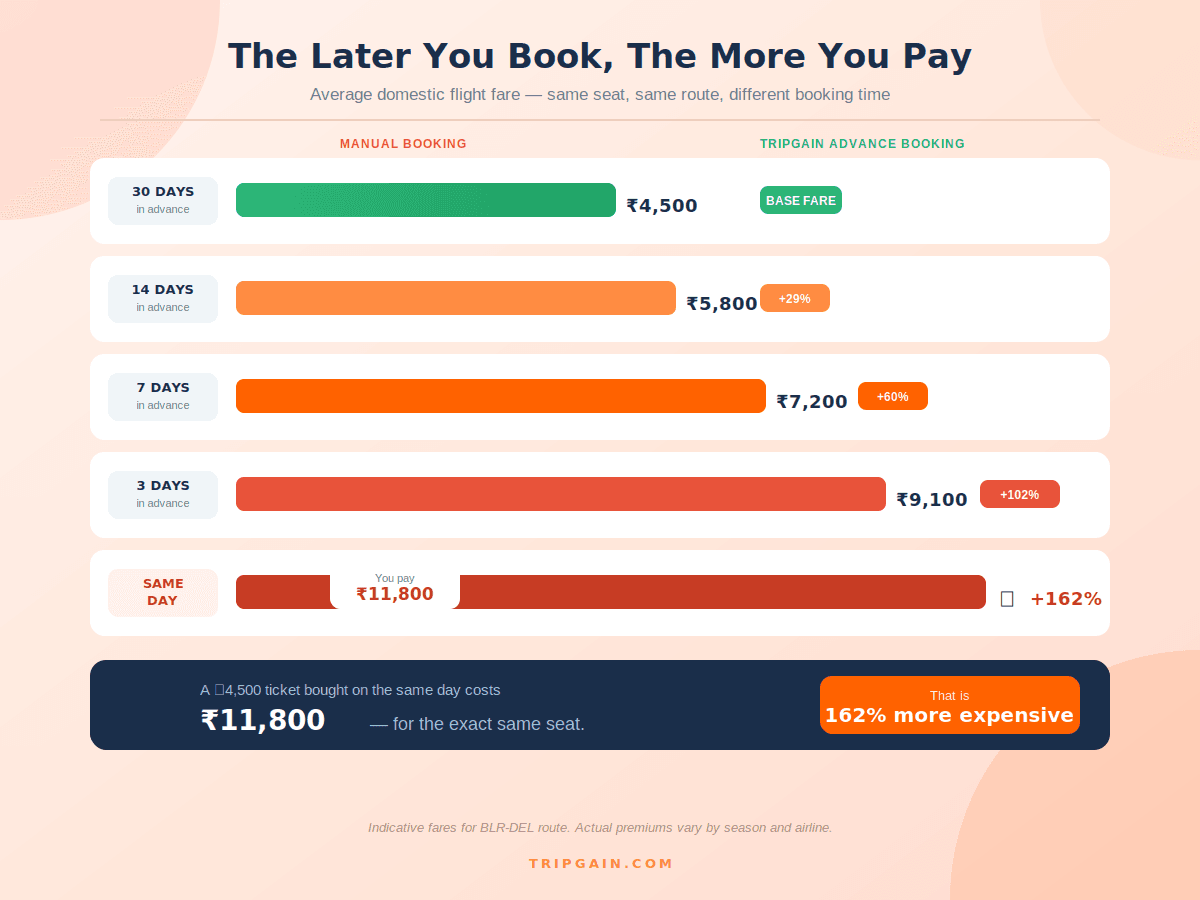
Either way, the ticket that could have been ₹4,500 is now ₹11,000.
That ₹6,500 difference is what we'd call a last-minute premium. It's real money that evaporates because the booking happened too late. And in most companies, this happens regularly. Not because people are careless. Because there's no system to plan travel in advance or flag when a trip is coming up.
Data from corporate travel platforms shows that booking a domestic flight within 24 to 48 hours of travel can cost anywhere from 40% to 80% more than booking the same seat two weeks earlier.
If your company takes 30 trips a month and even a third of them are last-minute, that premium adds up to lakhs over a year. Lakhs that left your account for no reason other than the timing.
The Duplicate Claim You Probably Paid
No one at your company is trying to cheat you. That's not what this is about.
But here's what happens.
Karan goes to Hyderabad. He pays for a cab from the airport. He uploads the receipt on WhatsApp. Finance doesn't see it immediately because there are 47 other messages in that group. Karan follows up. Finance says they'll handle it. Three days later, Karan uploads it again because he still hasn't been reimbursed and he genuinely isn't sure if the first one went through.
Finance reimburses both. Nobody catches it because there's no system comparing expense submissions to check for the same receipt uploaded twice.
This is not expense fraud. This is just what happens when expense management runs on screenshots and good intentions.
Ozonetel, one of TripGain's clients, found exactly this when they started tracking their expenses properly. Duplicate claims were going through regularly, not because employees were dishonest, but because the process made it impossible to tell what had already been submitted.
Once they had a system that caught duplicates automatically, that problem went away entirely.
Read Case Study: Ozonetel Reduces Travel Costs by 11-13% with TripGain’s Automated T&E Solution
The GST You're Leaving on the Table
This one genuinely hurts.
Every time your company buys a business flight or books a hotel, there's GST on that transaction. And in most cases, your company can claim that GST back as an input tax credit.
Most companies don't.
Not because they don't want to. Because claiming GST on travel requires the invoice to be raised in the company's name with the company's GST number. Airlines take 7 to 15 working days to generate GST invoices. Hotels sometimes need to be reminded three times to put the correct GST number on the bill. And if your employees are booking on their personal MakeMyTrip accounts or through an offline agent, there may not be a GST invoice at all.
For a company spending ₹5 lakh a month on travel, missing GST reconciliation means leaving anywhere from ₹45,000 to ₹90,000 in unclaimed credits every month. That's over ₹10 lakh a year. Sitting there. Unclaimed.
That's not a tax problem. That's a process problem.
The Hours Your Finance Team Doesn't Get Back
Picture the last three days of every month at your company.
Someone in finance is pulling together a travel expense report. They're cross-checking bills against bank statements. They're pinging people for invoices that haven't come in yet. They're trying to figure out which trip the ₹3,200 hotel bill from October belongs to. They're reconciling airline GST invoices that arrived 12 days after the trip happened.
On a good month, this takes 15 to 20 hours.
On a bad month, someone is at the office at 9 PM on the 31st, very tired, with a cold coffee, asking themselves how their career choices led them here.
Those hours are not free. Those are hours that cost you salary. And those are hours that your finance team is not spending on things that actually move the business forward, like understanding where costs are going, what can be negotiated, and what your travel spend is actually telling you.
Companies that have moved to automated travel management consistently report getting those hours back. TripGain clients typically close their travel books 5 times faster than before. Not because magic happened. Because the system tracks everything as it happens, so there's nothing left to reconstruct at month-end.
The Visibility You Don't Have
Quick question.
Right now, without calling anyone or opening any sheet, can you answer these questions?
How much did your company spend on travel in the last 30 days? Which team spent the most? Which employee flew business class when they weren't supposed to? How many trips went out of policy? What was the average hotel rate per night in Delhi last quarter?
If any of those felt like trick questions, that's the visibility gap.
When travel is managed through emails and WhatsApp and offline agents and personal booking accounts, the data is everywhere except where it should be. And without data, there's no control. Without control, there's no optimization. And without optimization, you're just spending and hoping.
Companies that have proper travel data can negotiate better rates with airlines because they can show actual booking volume. They can catch policy violations before they become habits. They can see which routes are most expensive and plan smarter. They can give their CFO a clear report in two clicks instead of three days.
Information isn't just nice to have. For a finance team, it's the whole job.
So What Does This Actually Add Up To?
Let's put rough numbers to it, just to make the point real.
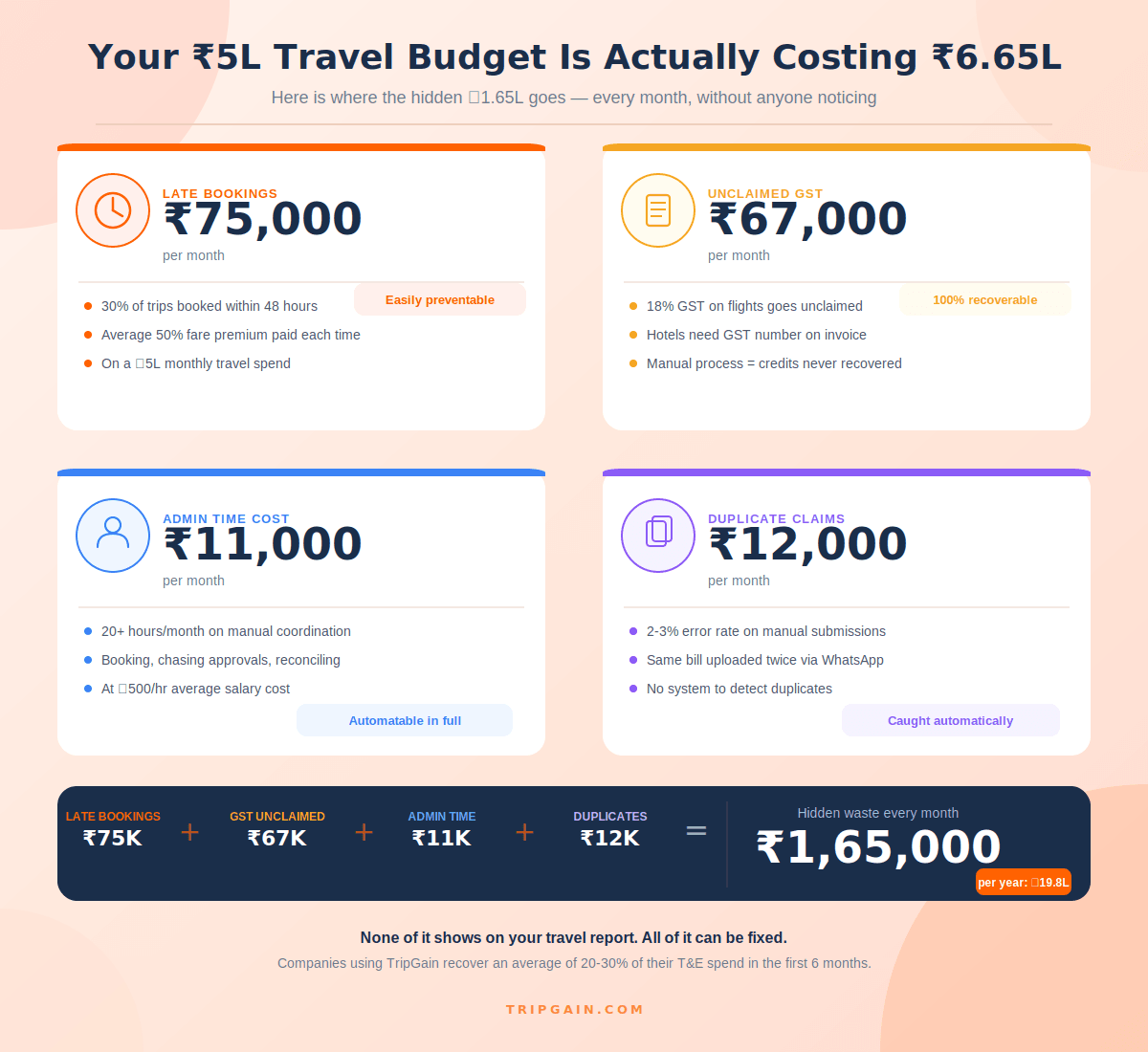
Take a mid-sized company with 200 employees, around 40 of whom travel regularly. Monthly travel spend of about ₹5 lakh.
Booking admin time: 20 to 25 hours a month. At ₹500 per hour for the people involved, that's ₹10,000 to ₹12,500 a month in hidden people cost.
Last-minute booking premiums: If even 30% of trips are booked within 48 hours, and the average premium is 50%, that's an extra ₹75,000 a month on a ₹5 lakh travel budget.
Unclaimed GST credits: On ₹5 lakh of travel spend, that's roughly ₹45,000 to ₹90,000 a month in credits that most companies never actually recover.
Duplicate and incorrect claims: Even 2 to 3% error rate on expenses, which is low for a manual system, is ₹10,000 to ₹15,000 a month going out incorrectly.
Add those up and you're looking at ₹1.4 lakh to ₹1.95 lakh per month in costs that never show up on any travel line item. On an annual basis, that's ₹17 lakh to ₹23 lakh.
That's not the travel budget. That's what the travel budget is quietly hemorrhaging into avoidable waste.
The Good News
None of these are unsolvable problems.
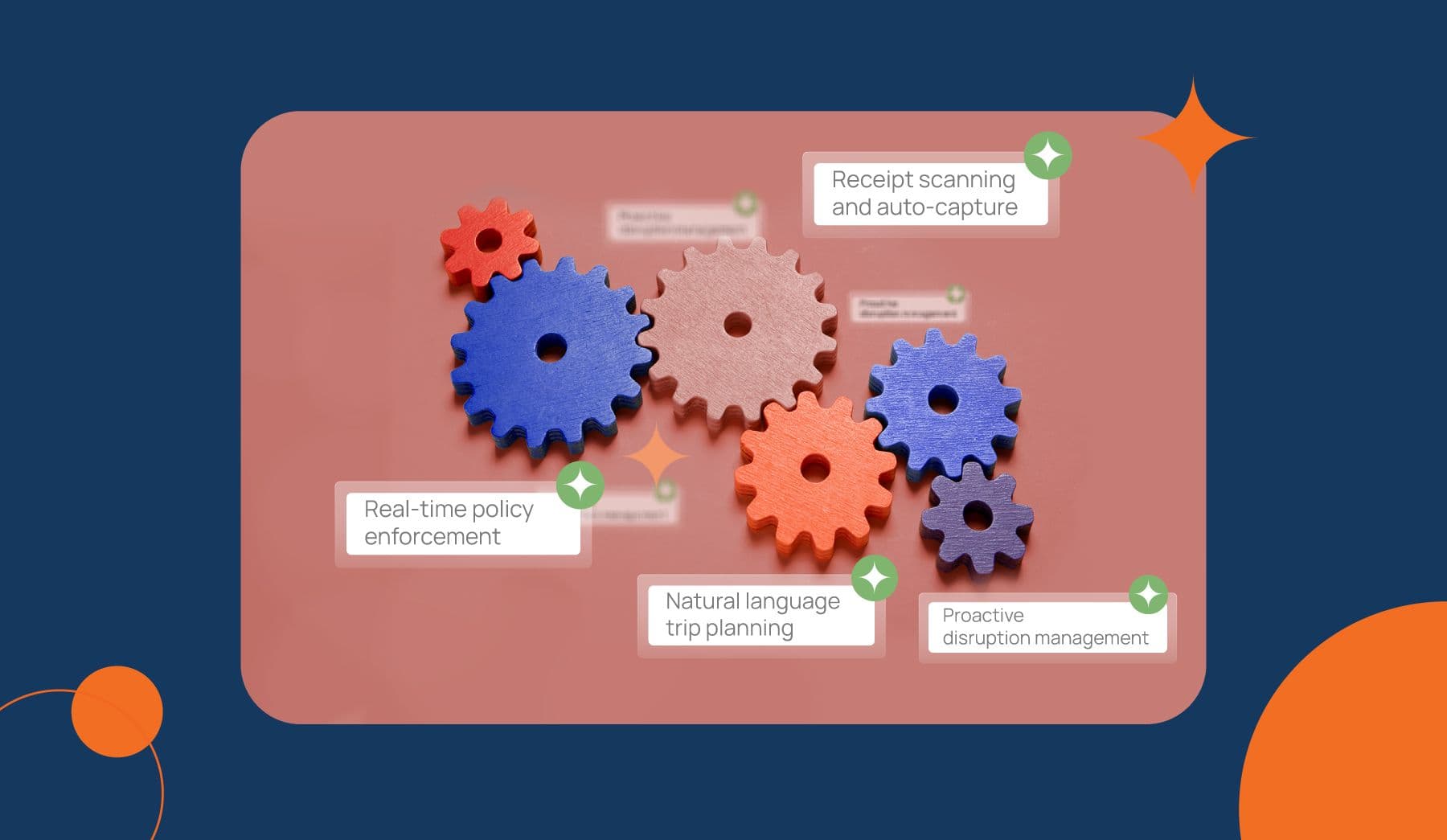
They're all process problems, which means they have process solutions. A system that tracks bookings properly eliminates the admin scramble. A platform that flags policy violations in real time reduces out-of-policy bookings. Automated GST reconciliation captures the credits that currently go unclaimed. Duplicate detection stops the same bill from being paid twice. And real-time dashboards give finance teams visibility without the month-end archaeology.
Companies like Ozonetel cut their travel costs by 13% within months of switching to TripGain. Immuneel saved ₹12 lakh per month. Proklean brought down hotel costs by 3x.
None of them did it by telling their employees to travel less. They just got a system that made travel visible, controllable, and efficient.
The company that loses ₹20 lakh a year to travel inefficiency doesn't feel it happening. It disappears in small amounts, across many months, into gaps that nobody has time to look at carefully.
But it's there. And now you know where to look.
Want to see how much your company is actually losing? TripGain's ROI calculator gives you a number in under 2 minutes. Or if you'd rather just see the platform, contact us and we'll show you how it works for a company your size.

Godi Yeshaswi
Senior Product MarketerIn this article
1.The Ticket Price Is the Easy Part
2.The Last-Minute Tax Nobody Talks About
3.The Duplicate Claim You Probably Paid
4.The GST You're Leaving on the Table
5.The Hours Your Finance Team Doesn't Get Back
6.The Visibility You Don't Have
7.So What Does This Actually Add Up To?
8.The Good News

Related Blogs