The CFO's New Superpower: Why AI Spend Copilots Are Rewriting How Finance Leaders Control, See, and Act on Every Dollar

There's a question every CFO has been asked in a board meeting: "How much are we spending on X?"
A simple question. A complicated answer, if your finance team is still relying on month-end reports, spreadsheet lookups, and chasing down department heads for data that should have been at your fingertips.
The CFO who can answer that question in ten minutes, not three days, isn't working with better spreadsheets. They're working with a fundamentally different model of how financial intelligence is generated and consumed. That model has a name now: the AI Spend Copilot.
This isn't a product conversation. It's a strategy conversation about how the finance function needs to evolve, what's finally possible with large language models and real-time data integration, and why the CFOs who move early will build a compounding strategic advantage that goes far beyond operational efficiency.
The Burning Platform No One Talks About Honestly
Finance leaders are drowning in a paradox. They are responsible for the most data-rich function in the enterprise, and yet most of them are making decisions in the dark.
A 2023 survey found that 89% of CFOs admit to making decisions based on inaccurate or incomplete data on a monthly basis. 98% say they are bogged down by low-value tasks like manual data collection and reporting ; tasks that delay the strategic work they were hired to do. 25% have put off revenue-generating initiatives entirely due to these inefficiencies.
Source: https://www.cbh.com/insights/articles/real-time-financial-visibility-for-cfos/
The root cause is structural. Most organizations built their finance infrastructure around the assumption that data would be collected, reconciled, and reviewed in cycles; weekly, monthly, quarterly. That assumption made sense when the pace of business was measured in quarters. It doesn't hold in an era where decisions need to be made in days, pricing changes happen overnight, and the cost of a delayed insight can be millions of dollars.
The travel and expense function is the most visible symptom of this dysfunction. More than 60% of travel and finance managers still process expense reports manually. Nearly 1 in 5 expense reports contains errors, from lost receipts and miskeyed amounts to duplicate submissions. 61% of finance executives reported their T&E policies were frequently or sometimes violated in recent years, and 73% agreed that violations would grow worse as their companies scale.
Generate your travel policy for free - https://tripgain.com/aipolicy
Source: https://www.cfodive.com/spons/reducing-te-policy-violations-3-steps/720815/
This isn't a compliance problem. It's an intelligence problem. And it won't be solved by adding headcount or enforcing stricter policies. It will be solved by a fundamental rethinking of how financial data is captured, interrogated, and acted on in real time.
Expense Management vs. Spend Intelligence: A Critical Distinction
For too long, "expense management" and "spend intelligence" have been treated as synonyms. They are not, and the distinction matters enormously for how CFOs think about technology investment.
Expense management is operational and reactive. It processes transactions after employees have already spent money, enforces policies retroactively, and generates reports that describe the past. Done well, it ensures reimbursements are accurate, receipts are captured, and approvals are documented. Done poorly, it creates bottlenecks, inflates processing costs, and buries finance teams in administrative work.
Spend intelligence is strategic and proactive. It connects intent to action; linking purchase decisions, travel bookings, vendor contracts, and departmental budgets into a live, interrogatable layer of financial reality. It doesn't just tell you what happened; it tells you what's about to happen, where policy is at risk of leakage, and what decisions need to be made today to protect margins tomorrow.
The most advanced finance organizations are moving deliberately from one to the other. Real-time data isn't about fancy dashboards. It's about making the right decision at the right moment, not three weeks after it mattered. That's the architectural shift that AI spend copilots are enabling.
Why Conversational AI Changes Everything for Finance Teams
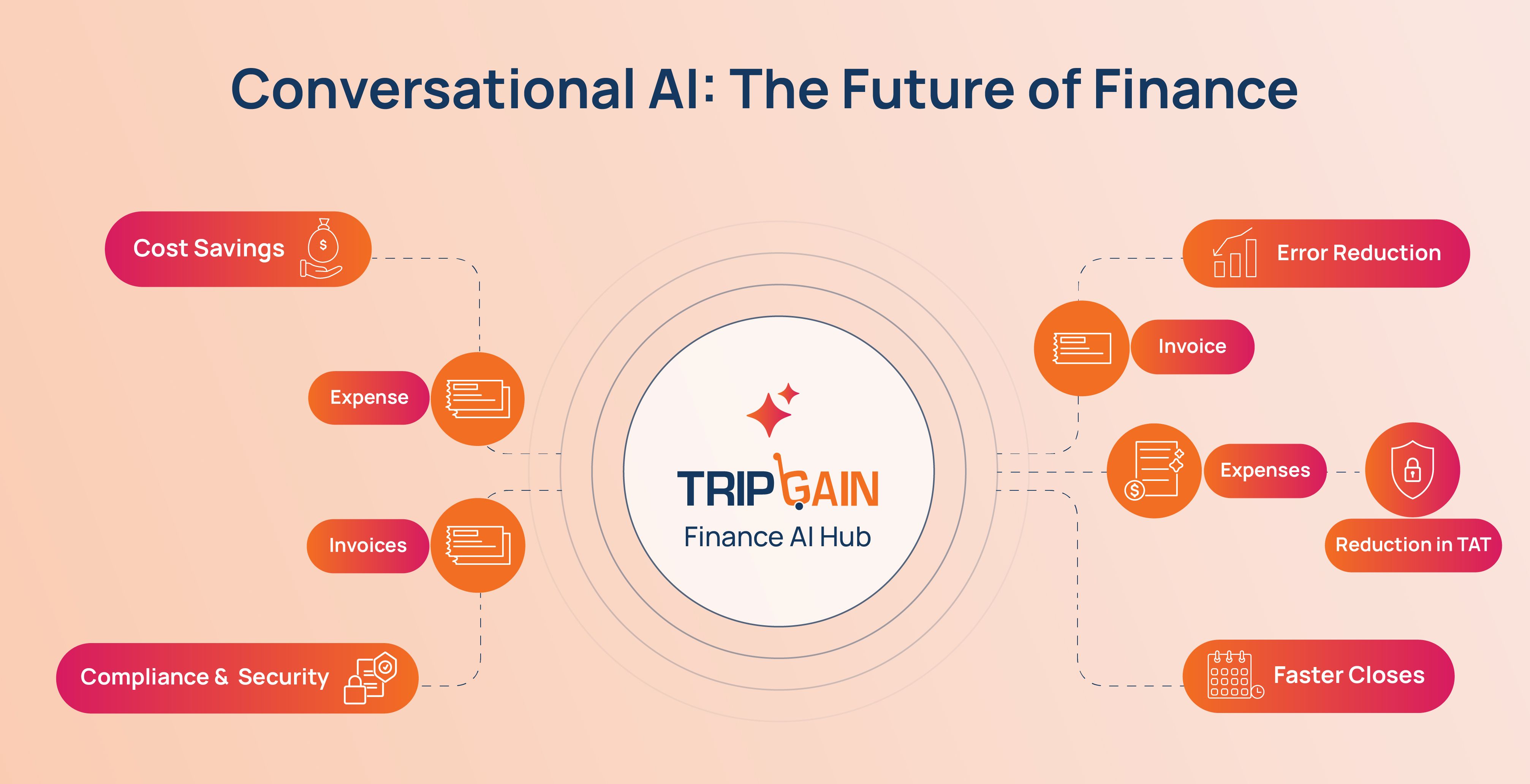
The technological building blocks of spend intelligence have existed for years. ERP systems, corporate card feeds, booking platforms, and analytics tools all generate enormous volumes of financial data. The problem was never the absence of data. It was the absence of a human-scale interface to that data, something that allowed a non-technical finance leader to ask a complex question and get a trustworthy answer in seconds.
Large language models (LLMs) have solved that interface problem in a way that no prior technology generation could. The shift is from querying systems to conversing with them.
Consider what this means in practice. A CFO preparing for a board presentation no longer needs to wait for a data analyst to run a custom query, format the output, and validate the numbers. They can ask: "Which departments have exceeded their annual travel budget, broken down by entity?" and receive a structured, board-ready answer within seconds; drawing from live data, not last month's export. They can ask: "What's our projected November travel spend given current bookings?" and receive an AI-generated forecast that accounts for historical patterns, confirmed bookings, and seasonality.
This capability, often called "Ask and Get" in the context of spend copilots, represents a genuinely new model of financial decision-making. It's not automation in the traditional sense. Automation executes predefined tasks. AI copilots augment judgment. They make the CFO faster, better-informed, and more independent from the bottlenecks that previously slowed financial decision cycles.
The scale of this shift is reflected in adoption data. 44% of finance teams are expected to use agentic AI in 2026, a greater than 600% increase over the previous year.
According to PwC, AI agents can redirect 60% of finance teams' time from data processing to insight generation, and improve forecasting accuracy and speed by up to 40%. No previous enterprise technology wave has produced adoption rates or efficiency gains at this velocity.
Source: https://neurons-lab.com/article/agentic-ai-in-financial-services-2026/
The Four Strategic Jobs an AI Spend Copilot Does for a CFO
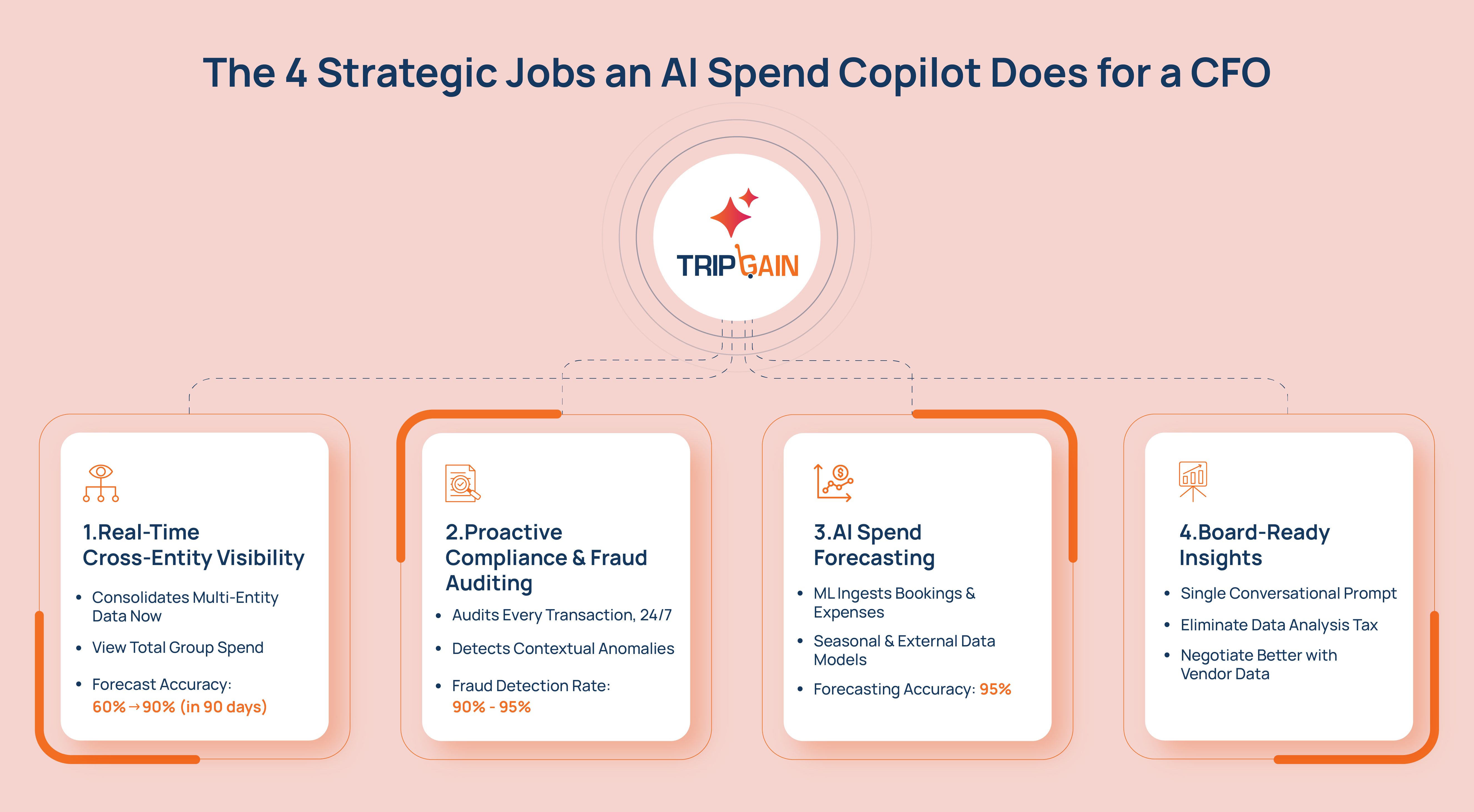
Understanding what an AI spend copilot actually does, beyond the demo - is critical to separating genuine capability from rebranded automation. The best implementations solve four distinct strategic problems.
1. Real-Time Visibility Across Entities and Geographies
Multi-entity organizations have historically faced a version of the visibility problem on steroids. Each entity runs its own approval workflows, books travel through different channels, and does expense reconciliation on its own schedule. By the time finance consolidates a picture of total group spend, the window to act has passed.
AI spend copilots normalize and aggregate this data into a single interrogatable layer, enabling CFOs to see total T&E exposure across all entities in real time, without waiting for month-end consolidations. Finance teams that were previously operating with 60% forecast accuracy have seen it improve to 90% within 90 days of deploying AI-based spend visibility tools.
2. Proactive Policy Compliance and Fraud Prevention
Policy violations don't happen because employees are dishonest. They happen because policy information is buried in static PDFs, accessible only to those who know where to look. When employees book travel without real-time policy guidance, the result is predictable: upgrades that weren't approved, bookings outside preferred vendors, duplicate submissions that slip through manual review.
Companies lose up to 5% of revenue annually due to expense fraud and policy violations. Expense reimbursement fraud alone accounted for 13% of all occupational fraud cases in 2024, with a median loss of $50,000 per incident. Manual audit processes catch only a fraction of violations, AI-powered systems can audit every transaction, not just a sample, identifying contextual anomalies that manual reviewers miss entirely.
Source: https://www.expenseout.com/business-expense-reimbursement-management-statistics-and-trends/
The shift from sampling to full-population auditing is not incremental. It's transformational. AI fraud detection rates run between 90-95%, compared to the hit-or-miss nature of periodic manual review. For enterprise finance leaders, this translates directly to margin protection.
3. AI-Driven Spend Forecasting
Accurate T&E forecasting has been notoriously difficult. Static historical data ages quickly, doesn't account for confirmed-but-unsubmitted bookings, and misses seasonal events unique to each organization. The result is that cash flow planning for travel spend is, as one industry analysis notes, "largely guesswork based on past static data".
AI spend copilots solve this with machine learning models that ingest historical spend data, currently booked but unexpensed trips, seasonal patterns, and external variables simultaneously. The accuracy improvements are substantial: leading implementations are reporting 95% forecasting accuracy, with direct impact on working capital optimization and liquidity planning.
This matters disproportionately for rapidly scaling organizations where travel spend grows non-linearly with headcount, and for businesses with concentrated travel activity; sales-intensive companies, professional services firms, and global enterprises with frequent cross-border movement.
4. Board-Ready Insights Without the Analytics Tax
The "analytics tax", the hidden cost of producing finance reports is one of the most underacknowledged drains on CFO bandwidth. Producing a board presentation on T&E performance typically requires a data analyst to pull raw data, a finance manager to format and validate it, and a senior leader to interpret and contextualize it. This chain introduces delays, errors at each handoff, and a structural lag between when data is generated and when it informs decisions.
AI spend copilots collapse this chain. Instantly uncover top vendor spend to fuel stronger negotiations, automatically audit every transaction to catch policy leakage, and deliver board-ready summaries from a single conversational prompt. The finance leader becomes the analyst, not by developing new technical skills, but by gaining access to a natural language interface that was previously unavailable to them.
The CFO as Strategist: AI Is Making the Transformation Real
The evolution of the CFO from financial controller to business strategist is not a new concept. It has been discussed for a decade. What has changed is that AI is finally making it structurally possible, not as an aspiration, but as an operational reality.
In 2026, the CFO role is no longer defined primarily by financial stewardship. It is about shaping technology strategy, navigating regulatory complexity, and driving AI-enabled transformation across the enterprise. According to a Fortune survey of leading CFOs, the finance leaders of 2026 are collectively anticipating AI moving from experimentation to enterprise-wide results that redefine finance as a more proactive and strategic function.
The organizations enabling this transition are those that have built what analysts now call "spend intelligence infrastructure", a unified layer connecting travel, expenses, procurement, and vendor data in real time, governed by AI that can surface anomalies, generate forecasts, and answer ad hoc queries without human mediation.
The business case for this investment is no longer abstract. The average cost to manually process an expense report is $26.63; fully automated processing reduces that to $6.85, a 74% reduction in processing cost. Organizations that automate expense management reduce processing time by 60% and cut costs by 35%. AI-powered finance automation has been linked to 25% cost savings across key processes in finance teams.
Source: https://www.wolterskluwer.com/en/news/evolving-cfo-5-strategic-trends-reshaping-finance-leadership
But the more important number isn't the savings. It's the hours recovered and redirected. Finance professionals freed from manual processing become analysts, advisors, and strategists. Controllers become transformation leaders. The finance function evolves from cost center to strategic partner, and the compound effect of that transformation is difficult to quantify but impossible to ignore.
What CFOs Should Evaluate When Assessing AI Spend Copilots
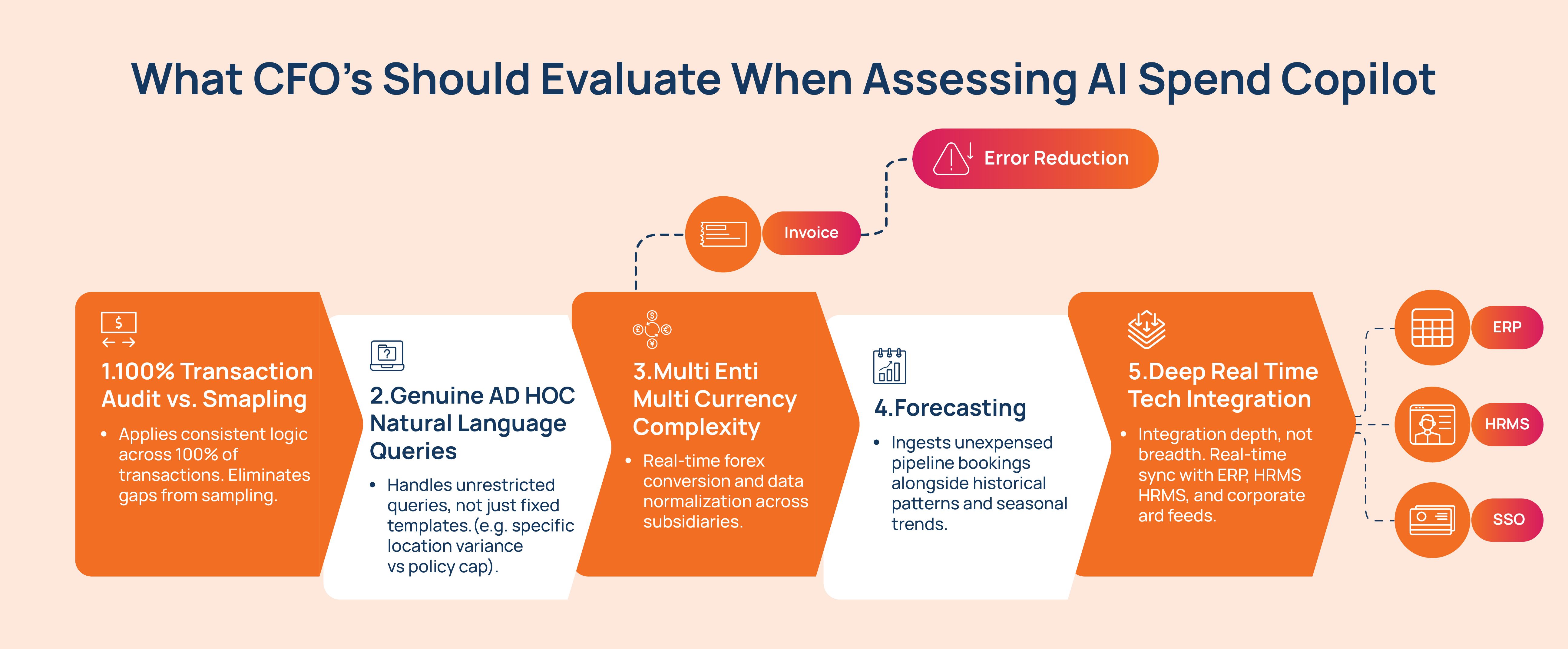
Not all "AI" capabilities in finance are equal. The industry is in an early phase where genuine intelligence is frequently conflated with basic automation relabeled for a new market. Finance leaders deserve a rigorous evaluation lens.
Five questions every CFO should ask before deploying a spend copilot:
- Does it audit every transaction, or only sample? A genuine AI spend copilot applies consistent logic across 100% of transactions, not a periodic sampling that leaves gaps. Ask vendors what percentage of transactions are audited and how anomaly detection is defined.
- Is the natural language interface genuinely ad hoc? Many systems offer fixed report templates with a conversational wrapper. True conversational spend intelligence handles unrestricted, ad hoc queries , "What's the variance between our actual Delhi hotel spend and our policy cap for Q4?" without pre-built report dependencies.
- How does it handle multi-entity, multi-currency complexity? Enterprise finance doesn't operate in a single entity. Evaluate how the system normalizes data across subsidiaries, handles forex conversion in real time, and surfaces consolidated insights without manual aggregation.
- What is the forecasting methodology? Forecasts based only on historical actuals miss currently booked but unexpensed spend. Look for systems that ingest pipeline booking data alongside historical patterns, seasonality indices, and planned events.
- How does it integrate with your existing tech stack? An AI copilot that doesn't sync with your ERP, HRMS, and corporate card feeds in real time creates a new data silo rather than eliminating existing ones. Integration depth, not just breadth, is the key differentiator.
The Stakes Are Real: What Happens If You Wait
The T&E management market is projected to grow from $4.08 billion in 2025 at a CAGR of 17.32%, reaching $11.7 billion by 2031. The acceleration of that growth reflects a competitive reality: organizations that deploy spend intelligence early gain compounding advantages in cost visibility, policy compliance, forecasting accuracy, and vendor negotiation leverage.
Source: https://www.mordorintelligence.com/industry-reports/travel-and-expense-management-market
The GBTA projects global business travel spending to reach $1.57 trillion in 2025 and surpass $2 trillion by 2029. India ranks among the fastest-growing top-15 markets globally. As travel volumes increase and spend complexity grows with remote-first and hybrid work models, the gap between organizations with AI spend intelligence and those without will widen, not narrow.
The CFOs who delay are not avoiding risk. They are taking a different kind of risk: the operational risk of continued decisions made on stale data, the financial risk of policy violations compounding at scale, and the strategic risk of losing the agility that competitors with real-time spend intelligence will increasingly demonstrate.
The tools exist. The ROI is documented. The strategic case is clear.
The question is no longer whether AI will transform how CFOs manage spend. The question is whether your organization leads that transformation, or responds to it.
The Shift That Can't Be Undone
There's a useful metaphor for what AI spend copilots represent. Finance teams that have operated without real-time spend intelligence are like navigators using paper maps, capable, experienced, skilled, but working with information that was true when it was printed, not when it needs to be used.
AI spend copilots are GPS: live, adaptive, capable of recalculating the route the moment conditions change, and able to answer questions in natural language that no static map was ever designed to handle.
The CFOs who get this right will be the ones who understand that this isn't a technology purchase. It's a redefinition of what the finance function is for. Not to report what happened. To shape what happens next.
In a world where the pace of business continues to accelerate, that capability, the ability to ask and get a trustworthy answer, instantly, about any dimension of your company's spend, is not a luxury. It is the foundation of strategic finance leadership.
This article reflects perspectives on AI transformation in the enterprise finance function, drawing on industry research, analyst reports, and adoption data from the global T&E and finance technology landscape.
Contact us at TripGain for more information on AI Spend Copilot

Godi Yeshaswi
Senior Product MarketerIn this article
1.The Burning Platform No One Talks About Honestly
2.Expense Management vs. Spend Intelligence: A Critical Distinction
3.Why Conversational AI Changes Everything for Finance Teams
4.The Four Strategic Jobs an AI Spend Copilot Does for a CFO
5.The CFO as Strategist: AI Is Making the Transformation Real
6.What CFOs Should Evaluate When Assessing AI Spend Copilots
7.The Stakes Are Real: What Happens If You Wait
8.The Shift That Can't Be Undone

Related Blogs