AI-Driven Spend Management: Why CFOs Need Real-Time Travel Expense Visibility

Most CFOs believe they have control over travel spend.
After all, there are dashboards. There are expense reports. There are policy documents. There is month-end reconciliation.
But here’s the uncomfortable truth - most finance teams only discover problems after the money has already moved. And in today’s volatile corporate travel environment, hindsight is expensive.
Spend Is Expanding, So Is Complexity
According to the 2025 GBTA Business Travel Index Outlook published by the Global Business Travel Association, global business travel spending is projected to reach approximately $1.57 trillion, reflecting sustained expansion in corporate travel activity.
At the macro level, the World Travel & Tourism Council reports that travel and tourism continues to represent a significant share of global economic activity, reinforcing the sector’s scale and systemic importance.
Meanwhile, airline economics remain dynamic. The International Air Transport Association (IATA) projects continued revenue growth and shifting profitability patterns in its Global Outlook for Air Transport (December 2025), a reminder that pricing environments are influenced by fuel costs, capacity constraints, and geopolitical variables beyond corporate control.
Spend, pricing, and global mobility are growing. But visibility remains fragmented.
The Quiet Cost of Fragmentation
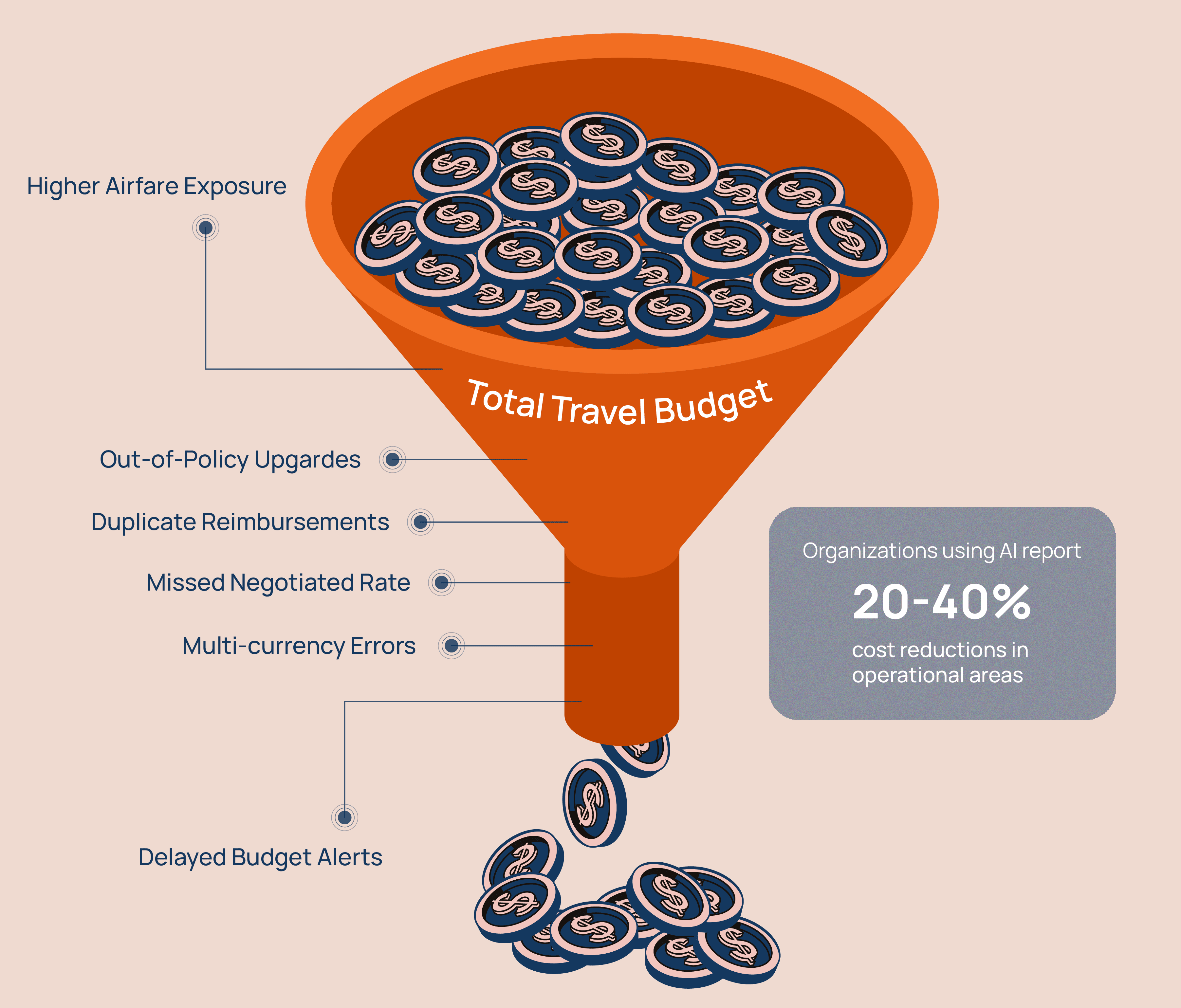
In most organizations, booking systems, expense management platforms, and ERP environments operate in silos. They reconcile after the fact rather than synchronize in real time. The result isn’t dramatic chaos, it’s friction that shows up as:
Late approvals that increase airfare exposure
- Out-of-policy upgrades slipping through
- Duplicate receipts missed during manual review
- Multi-currency categorization inconsistencies
- Missed negotiated supplier rates
- Budget overruns discovered weeks too late
Individually, each seems minor. Collectively, they distort forecasts and quietly inflate travel budgets.
The opportunity cost is measurable. According to McKinsey & Company in its latest State of AI research, organizations leveraging AI across business functions are seeing cost reductions in certain operational areas of 20-40%, driven largely by automation and improved decision intelligence.
Those gains don’t come from eliminating headline fraud. They come from tightening thousands of small inefficiencies that compound over time. Money rarely leaks in dramatic bursts. It erodes transaction by transaction.
Reactive Reporting Is No Longer Enough
Traditional corporate travel expense management is built around post-event validation. An employee completes a trip, submits an expense report, and finance audits it before reimbursement. It’s structured, compliant, and reactive. But by the time finance flags a discrepancy, the cost has already been incurred.
Meanwhile, executive pressure is intensifying. The PwC Global CEO Survey consistently highlights cost discipline and operational resilience as strategic priorities for global leaders.
In parallel, PwC’s US Pulse Survey reflects growing executive focus on AI investment and operational efficiency amid economic uncertainty. Finance leaders are expected not just to report performance, but to anticipate variance.
Descriptive dashboards are no longer sufficient. CFOs need predictive spend forecasting and real-time anomaly detection that identify risks while they are still forming.
AI Is Becoming Infrastructure, Not Experimentation
The AI transformation narrative is no longer theoretical. According to McKinsey & Company, AI adoption across enterprises has accelerated sharply in the past two years, with organizations embedding AI into core workflows rather than isolated pilots.
Within travel specifically, aggregated industry analyses such as those compiled by WiFiTalents highlight rapid adoption of AI in corporate travel processes, from dynamic pricing optimization to automated policy enforcement.
Technology investment is not slowing, and nor is the expectation that finance systems must do more than just record transactions. According to a report commissioned by Amadeus and conducted by Forrester Consulting:
- Nearly 78% of organizations cite cost reduction and operational efficiency as top priorities
- 73% rank digital transformation and improved data insights as critical to decision-making
- Only 31% of finance teams are satisfied with the current level of automation in their travel and expense tools
- Nearly 32% report lack of integration with other enterprise systems as a major dissatisfaction driver
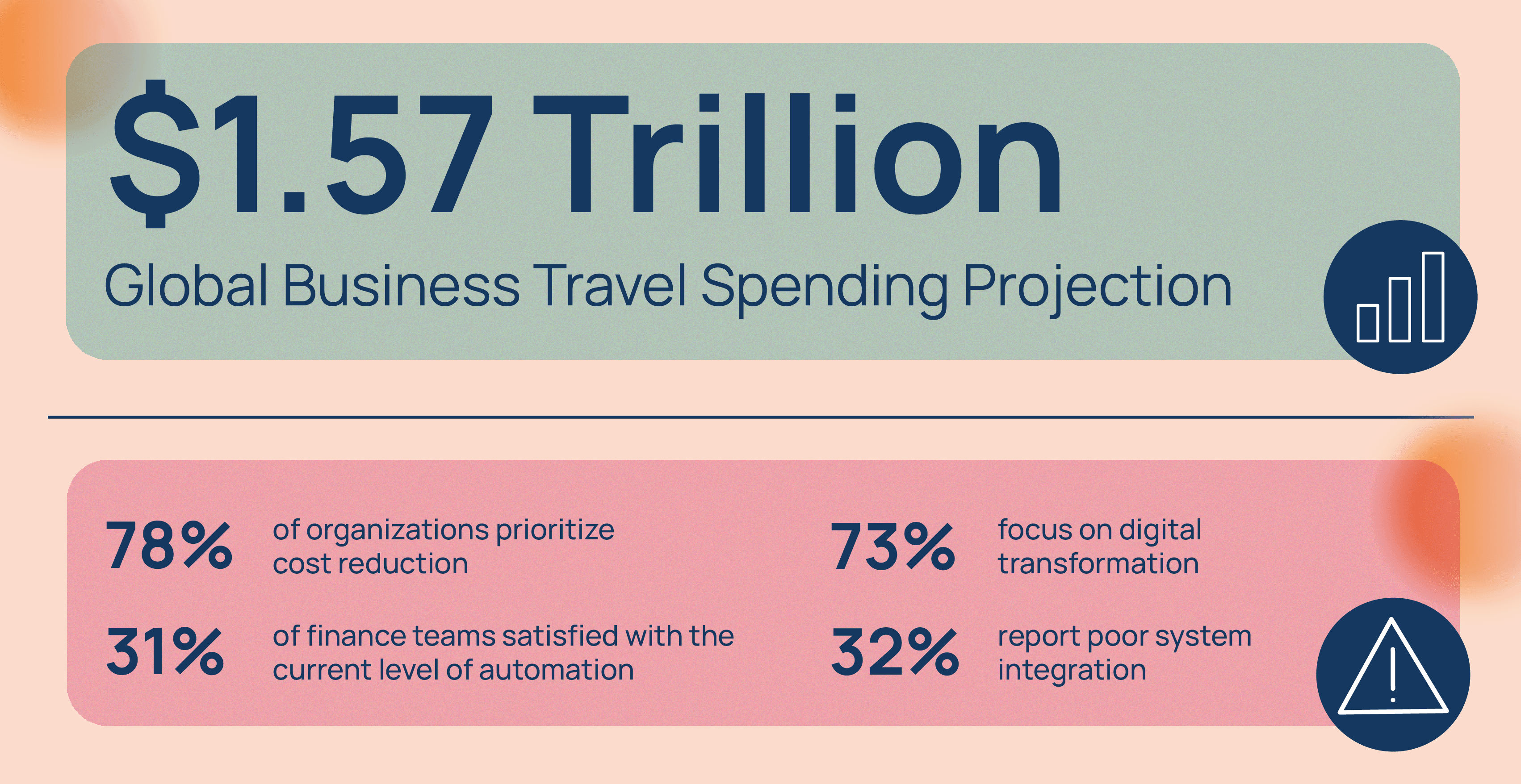
These numbers reinforce a clear message: finance leaders are demanding real-time visibility, intelligent automation, and deep system integration, and most legacy tools are not delivering.
What Modern Finance Teams Actually Need
Finance does not need more spreadsheets. It needs intelligence embedded into the flow of spend to enable:
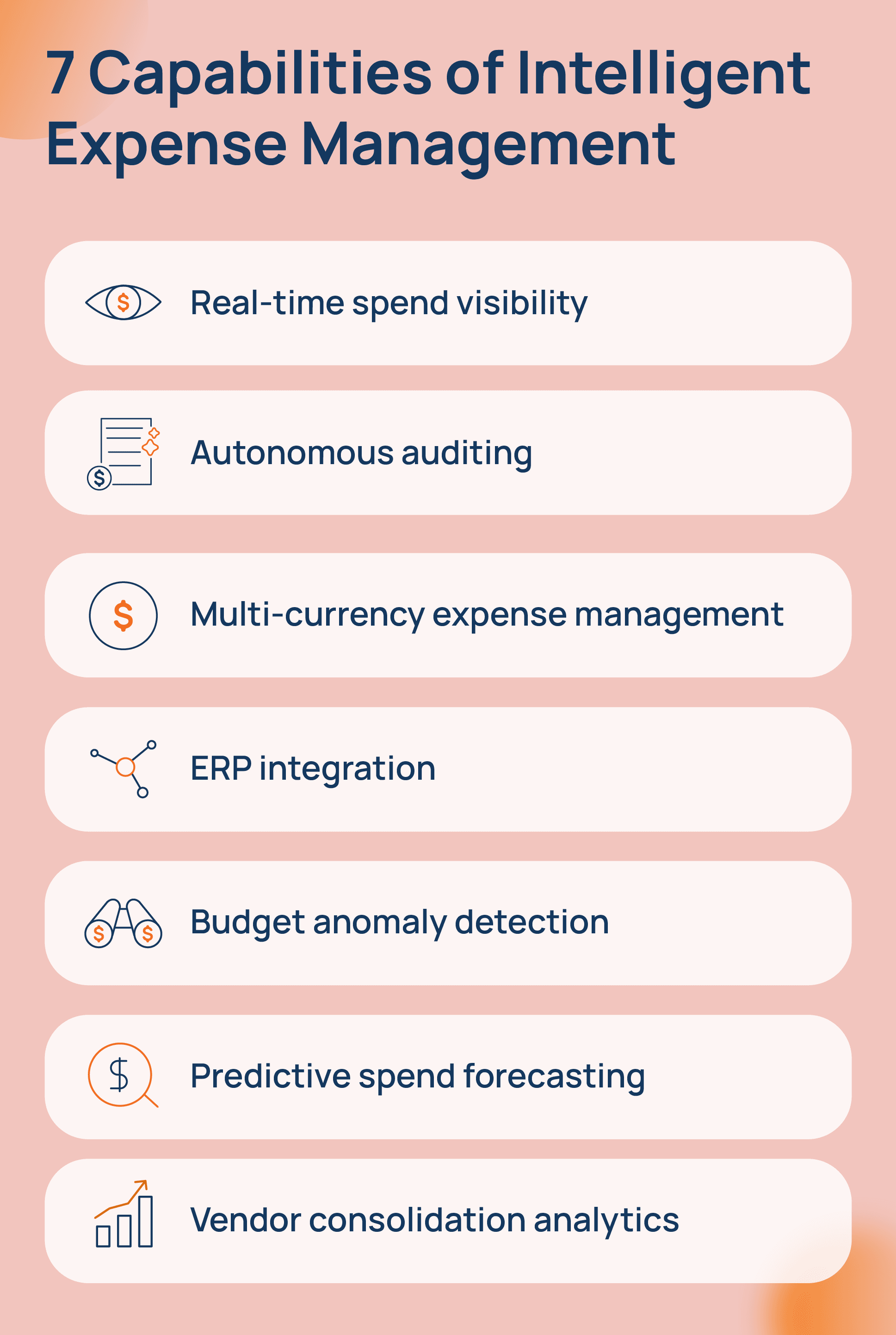
- Real-time spend visibility across bookings, expenses, and ledgers
- Autonomous auditing of every submitted expense against travel policy
- Instant anomaly detection for duplicates or unusual vendor pricing
- Multi-currency intelligence without manual reconciliation
- Natural language querying for direct executive insight
Imagine asking, “Show me Q3 travel spend by department versus budget, adjusted for currency movement” and receiving an accurate response instantly. No exports. No manual pivot tables. No lag. This is not convenience, it is operational acceleration.
The Booking-Expense Blind Spot
One of the largest structural gaps in corporate travel expense management is the disconnect between:
- Expected trip cost at booking
- Actual out-of-pocket spend
- Policy allowance
- Budget allocation
A trip may begin compliant. But itinerary changes, ancillary purchases, and timing shifts alter the final financial footprint. Without synchronization between booking systems and expense platforms, reconciliation happens after reimbursement, not before. And in a trillion-dollar global travel economy, ‘after’ is too late.
From Data Capture to Predictive Insight
AI-powered OCR has largely solved receipt capture. Systems can extract merchant details, line items, and transaction data with high accuracy. But capture is only the beginning, the real value lies in foresight:
- Identifying departments trending toward overrun before it occurs
- Linking slow approval cycles to fare increases
- Surfacing vendor consolidation opportunities
- Detecting repeat late-booking behavior patterns
- Quantifying savings from automated duplicate detection
According to the IATA report, airline revenue and cost structures continue to fluctuate, reinforcing the need for proactive cost management within corporate travel programs. In such an environment, static reporting is structurally insufficient.
The Rise of the Financial Copilot
Across industries, AI is reshaping finance operations into continuous intelligence systems.
The financial copilot model, reinforced by global AI research from McKinsey & Company and executive investment signals from PwC, represents an embedded intelligence layer that:
- Monitors spend continuously
- Enforces policy automatically
- Flags anomalies instantly
- Reconciles booking and expense data
- Alerts managers to budget drift
- Provides conversational financial insight
It reduces cognitive load while elevating finance from reactive auditing to proactive strategy. The CFO role is evolving from financial historian to financial anticipator. That evolution demands tools that do more than report, they must reason.
The Defining Question
CFOs do not lack dashboards. They do not lack reports. They do not lack policies.
They lack unified, real-time visibility across a fast-moving global spend category.
In a world where business travel is expanding toward multi-trillion-dollar scale, economically systemically significant, and influenced by dynamic airline economics, operating without predictive visibility introduces measurable risk.
The future of corporate travel expense management belongs to platforms that don’t just record transactions - they interpret them, learn from them, and prevent inefficiencies before they materialize.
CFOs don’t have a spend problem. They have a visibility gap.
And closing that gap is no longer about better reporting. It is about building an intelligent financial layer that sits between every booking, every expense, and every reimbursement - quietly protecting margin, enforcing compliance, and turning travel data into strategic leverage.

Disha Chatterjee
Senior Content MarketerIn this article
1.Spend Is Expanding, So Is Complexity
2.The Quiet Cost of Fragmentation
3.Reactive Reporting Is No Longer Enough
4.AI Is Becoming Infrastructure, Not Experimentation
5.What Modern Finance Teams Actually Need
6.The Booking-Expense Blind Spot
7.From Data Capture to Predictive Insight
8.The Rise of the Financial Copilot
9.The Defining Question

Related Blogs