5 Effective Ways to Improve Business Travel Policy Compliance Without Micromanagement
As organizations scale their business travel programs, policy compliance often becomes harder - not because rules are unclear, but because execution becomes fragmented. Travel decisions are increasingly made across multiple channels, teams, and geographies, while expense data surfaces only after trips are completed. This fragmentation directly weakens visibility and control. Research from the Center Expense Management Trends Survey highlights the extent of this challenge. Only 18% of employees book travel exclusively through approved corporate tools, while 82% book partially or entirely outside managed systems. Even among companies that have implemented corporate booking tools, 61% of employees still book off-platform, creating gaps between policy intent and real-world behavior. Compounding the issue, although 88% of organizations report having a written travel policy, nearly 49% cite lack of policy awareness among employees, and 31% identify policy compliance itself as a major challenge in managing travel and expenses.
For finance, procurement, and corporate travel leaders, these findings point to a critical insight - compliance failures are rarely driven by resistance, they are driven by disconnected execution. When policies live in documents but decisions happen elsewhere, organizations are forced into reactive controls such as post-trip audits, manual expense checks, and approval bottlenecks. These approaches increase administrative burden while frustrating employees, often pushing them further toward unmanaged channels. The more sustainable path forward lies in embedding compliance into the travel and expense journey itself, using automation, real-time guidance, and data-driven frameworks that influence decisions at the moment they are made. This shift from enforcement to enablement is what allows enterprises to improve compliance without resorting to micromanagement.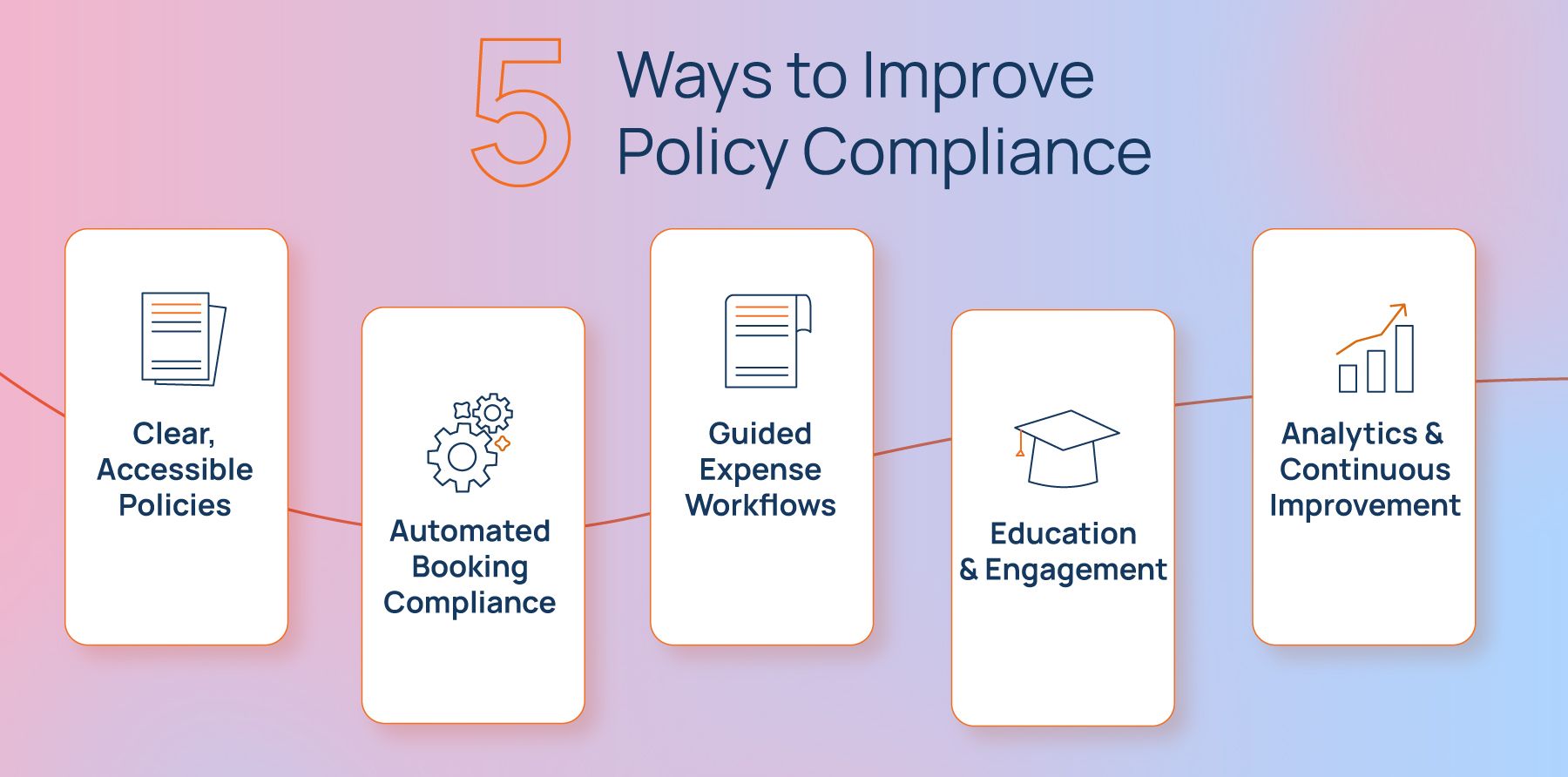
Here’s how travel decision makers can improve compliance without micromanagement.
1. Start With Clear, Accessible, and Relevant Policy Design
An effective policy begins before any travel is booked. If employees don’t understand what rules apply or why they exist, compliance rates will stagnate or decline.
Research shows that communication gaps are a major contributor to non-compliance. 79% of business travelers report that a company’s travel policy influences booking decisions more than convenience or cost. Yet many travelers feel disconnected from how policies are communicated and applied.
Actionable steps:
- Simplify policy language so that any traveler can understand it at a glance
- Publish policy summaries alongside FAQs and why these guidelines matter
- Share updates proactively via email or within booking platforms so that teams see changes in real time
- Align policies with current business goals, not just budget control
Clear policies reduce ambiguity, which leads to fewer discretionary interpretations and improved compliance without enforcement fatigue.
2. Automate Policy Enforcement at the Point of Booking
One of the most powerful ways to improve travel and expense policy compliance is through automation, especially when compliance checks happen before bookings are made.
Industry research shows that fragmented systems and manual processes remain key challenges for organizations managing corporate travel. Around 41% of organizations cite lack of integration between travel and expense systems as a major restraint, leading to inconsistent policy enforcement in nearly 29% of corporate trips. Automation, particularly tools that embed policy rules into the booking flow can help reduce these gaps.
From broader market trends, approximately 55% of corporations now use data analytics to optimize travel policies and spending, and nearly 50% have increased their investment in digital travel management platforms to improve efficiency and accuracy. These shifts underscore how automation and integrated systems are becoming central to policy compliance.
In practice, automating policy enforcement at booking:
- Steers travelers toward compliant choices in real time, reducing out-of-policy bookings before they happen
- Reduces manual approvals and corrections later in the expense cycle
- Enhances visibility for finance and travel teams, enabling proactive compliance without micromanagement
By building compliance into the booking experience itself, organizations can achieve higher adherence with less administrative friction and greater overall control.
3. Embed Policy Guidance in Expense Submission Workflows
Compliance does not end with booking. Expense reporting is often where policy breakdowns surface, particularly when processes are manual or fragmented. Disconnected travel and expense systems increase errors and slow reconciliation, making consistent policy enforcement difficult as travel volumes grow.
To address this, organizations are increasingly prioritizing digital expense management. Business travel data shows that over 60% of companies now invest in digital tools to improve expense accuracy, visibility, and compliance.
Effective compliance at the expense stage requires:
- Automated receipt capture and categorization to reduce manual errors
- Real-time policy cues during submission, helping employees correct issues instantly
- Centralized digital records to support faster reviews and audits
When policy guidance is embedded directly into expense workflows, employees comply more naturally, and finance teams gain cleaner data with less follow-up, improving compliance without added oversight.
4. Focus on Education and Engagement, Not Just Enforcement
True policy compliance improves when employees understand the rules and see them as enabling good decisions, not as restrictive hurdles. Research into corporate travel and expense systems shows that companies investing in traveler education achieve higher adoption of policy-aligned behaviors because employees are more confident and less likely to seek workarounds in unmanaged channels.
Instead of relying solely on approvals or post-trip audits, consider approaches that embed learning into everyday workflows:
- Introduce travel and expense policy training as part of employee onboarding, so expectations are clear from day one
- Provide periodic refreshers and updates when policies change or new tools are introduced
- Use dashboards and reports that show teams how compliance trends relate to budget performance, negotiated savings, or duty-of-care outcomes
- Highlight positive examples where compliant behavior led to better pricing, smoother approvals, or faster reimbursements
By fostering a culture of understanding and engagement, rather than enforcement and control, organizations can improve compliance organically and reduce reliance on micromanagement
5. Use Analytics and Reporting to Refine Policy Over Time
Travel and expense policies are not static. As travel patterns, costs, and business priorities change, policies must evolve to remain effective and relevant.
Industry research shows that organizations increasingly rely on data analytics to gain visibility into travel spend, compliance gaps, and operational inefficiencies, with analytics now a core component of modern travel management strategies. Regular review of travel and expense data helps identify recurring issues, such as frequent policy exceptions, department-level overspend, or categories with high manual intervention, before they become systemic problems.
A data-led approach enables organizations to:
- Identify root causes behind repeated policy exceptions
- Track compliance trends over time across teams and travel categories
- Refine policy thresholds and vendor preferences based on actual usage
- Benchmark performance using KPIs such as compliance rate, out-of-policy spend, and reimbursement cycle time
By using analytics as a feedback loop, compliance shifts from a one-time rule-setting exercise to a continuous improvement process, reducing friction for employees while giving finance and travel leaders better control without micromanagement.
Compliance Through Empowerment, Not Oversight
Improving travel and expense policy compliance doesn’t require heavy-handed enforcement. By focusing on clarity, automation, guided expense workflows, education, and analytics, corporate travel leaders can significantly improve compliance with minimal managerial oversight.
This approach not only protects the bottom line but enhances employee experience and strengthens governance. In today’s dynamic travel landscape, compliance becomes a strategic advantage, not a burden.
FAQs
1. Why does policy compliance decline as travel programs scale?
Because travel and expense activity becomes fragmented across channels and systems, reducing visibility and weakening execution.
2. How can compliance improve without adding approvals or controls?
By embedding policy rules and guidance directly into booking and expense workflows at the point of decision.
3. Is non-compliance usually intentional?
No. Most non-compliance stems from unclear policies, disconnected systems, or lack of real-time guidance.
4. How does technology help improve compliance?
Integrated platforms automate policy checks, centralize data, and enable real-time visibility with minimal manual intervention.
5. How often should travel and expense policies be reviewed?
At least biannually, using analytics to align policies with actual travel behavior and business priorities.

Disha Chatterjee
Senior Content MarketerIn this article
1.Start With Clear, Accessible, and Relevant Policy Design
2.Automate Policy Enforcement at the Point of Booking
3.Embed Policy Guidance in Expense Submission Workflows
4.Focus on Education and Engagement, Not Just Enforcement
5.Use Analytics and Reporting to Refine Policy Over Time
6.Compliance Through Empowerment, Not Oversight
7.FAQs

Related Blogs